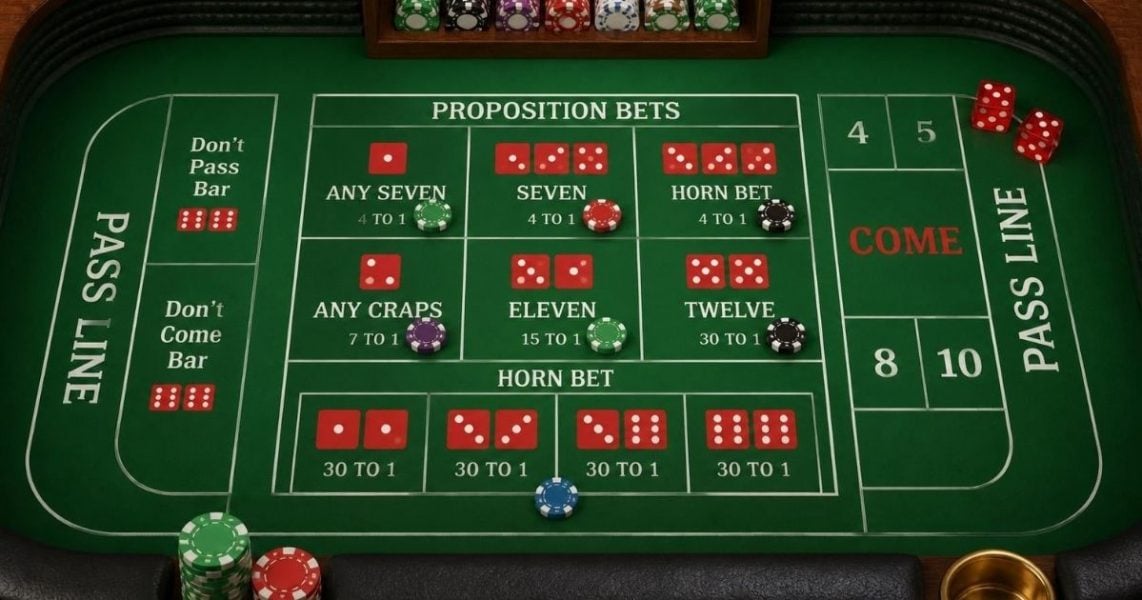
Craps proposition bets are the one-roll and hardway bets in the centre of the table. They pay big but are the worst value in the game, with house edges from about 9 percent up to nearly 17 percent on any seven. The pass line and odds bets are far cheaper, so the props are best kept to the occasional flutter.
Craps proposition bets are the bright, busy squares in the middle of the layout, the ones the casino most wants you to bet. They are the worst value in the game, offering tempting payouts in exchange for the highest house edges in craps. Each one is explained below with what it really costs, then ranked from bad to worst, so you know exactly what to skip.
- Proposition bets are the flashy centre bets. Any seven, the hardways, yo, aces and boxcars all live in the middle of the table.
- They are the worst value in craps. House edges run from about 9 percent up to nearly 17 percent.
- Any seven is the single worst bet. At 16.67 percent, it costs more than ten times the pass line.
- There is no skill to them. They pay big when they hit, but over time they simply cost more.
What are craps proposition bets?
Proposition bets are the wagers in the centre of the craps layout, the boxes you tap in the middle rather than the line and place bets around the edge. They come in two kinds: one-roll bets, which win or lose on the very next roll, and the hardway bets, which stay up until the number rolls a certain way or a 7 ends them. What they share is a high house edge and a big, tempting payout.
They are the opposite of the bets covered in our craps bets guide, where the pass line and free odds sit near 1.4 percent or lower. If you are still learning the game, our how to play craps guide covers the basics first. Here, the theme is simple: these are the bets to enjoy sparingly, if at all.
Any seven and the one-roll bets
The one-roll proposition bets are decided the instant the dice land. The most notorious is any seven, a bet that the next roll is a 7, paying 4 to 1. Since a 7 rolls 6 times in 36, the true odds are 5 to 1, and that gap gives any seven a 16.67 percent house edge, the highest of any standard craps bet and the textbook sucker bet.
The rest of the one-roll family follows the same pattern of flashy payout, poor value. Any craps, a bet on 2, 3 or 12, pays 7 to 1 for an 11.11 percent edge. Yo, the eleven bet, pays 15 to 1 at the same 11.11 percent. The aces (two) and boxcars (twelve) pay a huge 30 to 1 but cost 13.89 percent, and the ace-deuce (three) pays 15 to 1 for 11.11 percent. Big numbers, bad odds.
Hardway bets
The hardway bets are the other half of the centre layout, and they last longer than one roll. A hardway wins if a number comes up as a double, the hard way, before it rolls any other way or a 7 appears. Hard 8, for example, wins on 4 and 4 but loses if an 8 arrives as 6 and 2, or if a 7 rolls first.
Hard 6 and hard 8 pay 9 to 1 and carry a 9.09 percent house edge, the least punishing of all the proposition bets. Hard 4 and hard 10 pay 7 to 1 for a steeper 11.11 percent. They are more forgiving than the one-roll bets because they get several rolls to land, but they are still several times more expensive than a line bet.
Horn, C&E, whirl and hop bets
The remaining centre boxes are the one-roll bets bundled together, and bundling never improves the price. The horn splits four units across the 2, 3, 11 and 12 for a 12.5 percent edge; a horn high adds a fifth unit to one of them for 12.2 to 12.8 percent. C&E pairs any craps with the yo at 11.11 percent, and the whirl, or world, adds any seven to a horn for 13.33 percent, with a 7 returning your money rather than winning.
Hop bets name an exact pair of dice for the next roll: an easy hop such as 2 and 5 pays 15 to 1 for 11.11 percent, a hard hop such as 3 and 3 pays 30 to 1 for 13.89 percent. Online layouts also tend to print payouts as “for 1” rather than “to 1”, which quietly includes your stake: any seven at 5 for 1 is the same 4 to 1, but aces at 30 for 1 is only 29 to 1, and that pushes the edge from 13.89 to 16.67 percent, so read the paytable before you tap.
Craps proposition bets ranked by cost
Here is every proposition bet ranked from worst to least bad by house edge. Choose a bet size to see how much each one loses on average per wager. Compare that to the pass line, which loses about 14 cents per C$10 bet.
What to bet instead
The case against the proposition bets is not that they never win. It is that, roll after roll, they cost far more than they need to. Every dollar on any seven gives up nearly 17 cents in expected value, against just over one cent on the pass line. Over a session, that difference is the gap between entertainment and a fast empty wallet.
The better play is the one our craps odds and craps strategy guides keep coming back to: bet the pass line or don’t pass, back it with free odds, and place the 6 or 8 if you want more action. Keep the props for the odd bit of fun on a hot table, never as the heart of your game.
Sticking to the good bets
Knowing the proposition bets is mostly about knowing what to avoid. Enjoy the odd long shot if the mood takes you, but build your play around the pass line and free odds, where the house edge is a fraction of what the centre bets charge, and check whether the layout prints “to 1” or “for 1” before any prop bet. In the regulated markets, AGCO-registered Ontario casinos and AGLC-registered Alberta casinos publish the full prop paytable in each table’s rules panel.