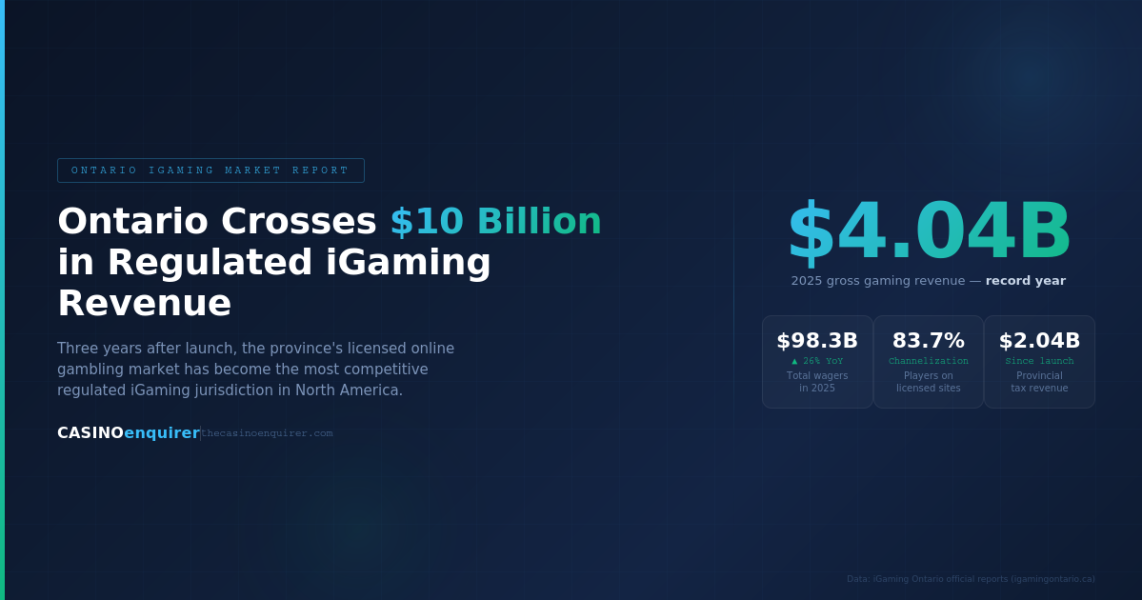
Ontario’s regulated iGaming market has now generated more than $10 billion in cumulative gross gaming revenue since opening in April 2022. The 2025 calendar year alone produced $4.0 billion on $98.3 billion in wagers, and 2026 has run ahead of that pace every month while year-over-year growth has begun to slow.
- Cumulative revenue has passed $10 billion, with roughly $2.04 billion returned to the province in tax.
- Growth is decelerating even as records fall. Casino revenue growth has slid from above 33 per cent year over year in January to 25.6 per cent in May.
- Channelisation has jumped to 91.1 per cent from 83.7 per cent a year earlier, the single most consequential number in this report.
- The operator field has stopped expanding. It has moved in a narrow band between 46 and 49 operators for over a year, churning at the edges rather than growing.
Ontario remains the only Canadian province publishing monthly market performance data, which makes it the reference point for measuring online gambling anywhere in the country. This report covers the full 2025 calendar year, 2026 year to date, and the trends underneath the headline figures. All amounts are Canadian dollars.
Ontario iGaming revenue passes $10 billion
Since the market opened on 4 April 2022, licensed operators in Ontario have generated more than $10 billion in cumulative non-adjusted gross gaming revenue.
That figure is worth stating carefully, because it is frequently misread. Gross gaming revenue is what operators retained after paying out winnings. It is not turnover, and it is not profit. It is, near enough, the amount Ontario players lost across four years of regulated play. Roughly $2.04 billion of it has flowed back to the province in tax.
The milestone matters less as a headline than as a measure of how quickly a market can form when it is given a legal structure. Ontario went from a single provincial platform in early 2022 to the most competitive regulated online gambling market in North America by operator count, and it did so in four years.
The 2025 calendar year
Licensed operators handled approximately $98.3 billion in wagers during 2025 and generated $4.0 billion in gross gaming revenue, increases of 26 and 34 per cent respectively.
Revenue grew faster than handle, which is the pattern that has defined this market since launch. It reflects the product mix shifting steadily towards online casino, where the operator retains a larger share of each dollar wagered than in sports betting.
December 2025 closed the year with what were then records across the board: $9.5 billion in wagering and $425.6 million in revenue, still the highest single month the market has recorded. Online casino accounted for 87 per cent of wagers and 75 per cent of revenue that month. Active player accounts reached 1.27 million by year end, up 24.5 per cent on 2024, and average revenue per active account hit a record $334.
| 2025 measure | Result |
|---|---|
| Total wagers | Approximately $98.3 billion, up 26 per cent year over year |
| Gross gaming revenue | Approximately $4.0 billion, up 34 per cent year over year |
| Record month | December, at $9.5 billion wagered and $425.6 million in revenue |
| Active player accounts | 1.27 million at year end, up 24.5 per cent |
| Revenue per active account | A record $334 in December |
| Competitive field | 48 licensed operators running 82 gaming sites |
For the fiscal year iGaming Ontario itself reports on, 2024-25, the market recorded $82.7 billion in wagers and $3.2 billion in gaming revenue, up 31 and 32 per cent on the prior year, across 49 operators and 84 sites. Casino accounted for $69.6 billion of wagers and $2.4 billion of revenue, betting for $11.4 billion and $724 million, and peer-to-peer poker for $1.7 billion and $66 million.
2026 year to date, month by month
Every month of 2026 published so far has run ahead of its 2025 equivalent, and two of them set records.
Three of the five set records. January put a record 1.326 million active player accounts into the market and took the all-time wagering record at $9.519 billion. March promptly beat that handle record at $9.592 billion. May then produced the highest online casino revenue ever recorded, at $326.4 million, on record casino handle of $8.371 billion, with total revenue of $413.1 million standing as the second-highest month the market has seen behind only December 2025.
Monthly performance, 2026 year to date
Click any column heading to sort. Record months are highlighted.
| Month▼ | Wagers▼ | Revenue▼ | Active accounts▼ | Per account▼ | Casino share of wagers▼ |
|---|
Source: iGaming Ontario monthly market performance reports, which are published for every month roughly four weeks after it closes. June is the next to land, and this table is updated as each report is released.
February looked worse than it was
February broke the run, and the headline numbers were stark: handle fell 8.2 per cent from January to $8.734 billion and revenue dropped 14.7 per cent to $342.4 million, both the lowest totals since September 2025. Average revenue per active account fell to $264, the weakest month since February 2025.
Almost all of the handle decline is a calendar artifact, and it is worth correcting because most coverage reported it as a slump. February has 28 days against January’s 31, a 9.7 per cent shorter month. On a per-day basis Ontario handled $312 million in February against $307 million in January, which is an increase of 1.6 per cent rather than a fall of eight. Revenue per day did soften, from $12.95 million to $12.23 million, but that is a decline of 5.6 per cent rather than the 14.7 per cent the monthly total implies.
The year-over-year comparison tells the same story. February 2026 handle and revenue were each around 22 per cent above February 2025, and online casino revenue climbed 29 per cent to $275.7 million from $214.0 million. A short month is a short month; it is not a market turning.
Taken together, the first quarter of 2026 produced $27.8 billion in wagers and $1.13 billion in revenue, implying roughly $226 million in provincial tax for those three months alone. Ontario’s 2026-27 budget projects about $294 million in revenue from private-sector iGaming operators across the full year.
On a trailing twelve month basis to the end of April, the market was running at $104.85 billion in wagers and $4.36 billion in revenue. That is the cleanest single measure of current scale, because it strips out the seasonality that makes individual months misleading.
Growth is slowing while records keep falling
Both things are true at once, and the second is the one that matters for anyone forecasting this market.
Online casino revenue grew by more than 33 per cent year over year in January. By May that had fallen to 25.6 per cent. The market posted above 40 per cent growth in the closing months of 2025 and has stayed under 30 per cent in three of the first five months of 2026, despite four of those months clearing $300 million in casino revenue. Absolute year-over-year gains have dropped below $70 million a month after regularly exceeding $90 million at the end of 2025.
This is what maturity looks like rather than weakness. A market cannot compound above thirty per cent indefinitely once channelisation approaches its ceiling and the addressable population is largely enrolled. Records will continue to fall for some time on absolute figures while the growth rate keeps easing, and confusing the two is the most common error in coverage of this market.
Where the revenue comes from
Ontario is a casino market with a sportsbook attached, and the gap is widening rather than closing.
| Vertical | May 2026 wagers | May 2026 revenue | Direction |
|---|---|---|---|
| Online casino | $8.371bn, 88% share | $326.4m, 79% share | Record on both measures. Share of handle up from 86% in January |
| Sports betting | $972m, 10% share | $81.3m, 20% share | Declining sequentially, from $1.18bn in January |
| Peer-to-peer poker | $134m, 1% share | $5.4m, 1% share | At record highs, but still a rounding error |
Casino’s dominance comes with a structural catch visible in the hold rate. Casino games returned only about 3.86 per cent of handle to operators as revenue in April, because slots and table games recycle the same money at high speed. Sports betting handle is far smaller but converts at a much higher rate. So the two verticals are not comparable on wagering volume alone, and any analysis that ranks them by handle is measuring the wrong thing.
Poker deserves a note despite its size. It set consecutive records through the first half of 2026, reaching $183 million in handle in March, but remains confined to an Ontario-only player pool. The Government of Ontario referred the question of international liquidity to the Court of Appeal; the reference was heard in late 2024 and the decision remains reserved. A ruling permitting shared liquidity is the single change that could alter this vertical’s trajectory.
The number that matters most: 91.1 per cent
AGCO data now puts 91.1 per cent of Ontario online gamblers playing exclusively on regulated platforms, up from 83.7 per cent a year earlier.
That is a remarkable jump in a single year, and it is the metric against which the entire policy should be judged. Ontario’s stated purpose in opening a competitive market was to move play out of the offshore grey market and into a supervised one. On this measure it is working faster than most forecasts allowed for.
The residual matters too. Roughly one player in eleven is still outside the regulated market, down from one in six a year ago. Those players have no access to the province’s dispute processes, no deposit limits enforced by a regulator, and no route into centralised self-exclusion. The channelisation figure is therefore both a success measure and a map of who remains unprotected.
The operator field has stopped expanding
Ontario had 48 licensed operators running 82 gaming sites in January 2026, dipped to 46 across 80 by May, and was back at 48 and 82 on iGaming Ontario’s own register in late July.
The field peaked around 49 operators and 84 sites during the 2024-25 fiscal year and has moved within a narrow band ever since. That is the more accurate reading: not a decline, but a market that has stopped expanding and now churns at the edges as entrants meet the compliance cost and others take their place. Anyone citing a single month’s count as evidence of contraction is reading noise as trend.
The direction of travel among those remaining is towards casino specialisation. Operators including FanDuel and DraftKings, both built originally on sports betting, have prioritised standalone casino products in Ontario as a direct response to where the revenue actually is. That is a rational response to an 88 per cent casino share of handle, and it reinforces the vertical concentration described above.
For anyone tracking which operators are currently licensed rather than which were licensed last year, the practical answer is iGaming Ontario’s directory of registered sites, which carries its own as-at date. Our guide to how online gambling works in Ontario explains what AGCO registration and an iGaming Ontario agreement actually require of an operator.
Player accounts and spend per account
Active accounts peaked at 1.32 million in January 2026 and have settled between 1.23 and 1.27 million through the spring.
The seasonal shape is now well established: accounts build through the autumn, spike around the turn of the year, then ease back through the first half. The underlying trend is still clearly upward. Ontario counted 1.257 million active accounts in May, against 1.068 million a year earlier and 816,000 the year before that, a 54 per cent increase across two years.
Average revenue per active account has risen faster than account growth. It reached $321 in April, up 11.8 per cent year over year, against a record $334 in December. That combination, modest account growth alongside faster revenue-per-account growth, means existing players are spending more rather than the market simply reaching more people. It is the metric a regulator watches most closely, and it is the reason the harm-reduction measures below arrived when they did.
What has changed in the framework this year
Three developments in 2026 bear on the numbers above, and two of them are designed to restrain them.
Centralised self-exclusion launched on 14 May 2026. BetGuard lets anyone aged 19 or over opt out of every regulated site in the province through a single portal, including OLG’s platform, with terms from six months to five years and no gambling account required to sign up. Ontario had operated without this for four years; it is the most significant consumer protection added since launch.
OLG introduced a deposit-limit requirement for younger players in June 2026, obliging online players under the age of 25 to set a deposit limit. It applies to OLG’s own platform rather than market-wide, but it signals the direction of provincial thinking on age-banded harm reduction.
A private member’s bill would restrict advertising much further. The Stop Harmful Gambling Advertising Act, amending the Gaming Control Act, would as drafted prohibit licensed operators and the firms that market their services from advertising through any medium. It is a bill rather than law and may not pass, but it would reach publishers as well as operators, and it is the most consequential open question facing this market’s commercial model.
Alberta’s own competitive market opened on 13 July 2026 on a structure closely modelled on Ontario’s. Shared liquidity between the two provinces has been mooted but not confirmed. Our guide to online gambling in Alberta covers how that market differs.
Data sources and methodology
All wagering and revenue figures come from iGaming Ontario’s published market performance reports and its annual report. Channelisation is from AGCO data. Operator and site counts are the most recent public figures and change through the year.
Three notes on reading them. Revenue is non-adjusted gross gaming revenue, reported before Ontario’s 20 per cent iGaming tax and before operating costs, so it is neither turnover nor profit. Wagers are total cash wagers including rake, tournament and other fees, and exclude promotional wagers. And iGaming Ontario’s reporting covers the private licensed market rather than OLG’s platforms, which report separately, so provincial totals including OLG are higher than the figures here.
iGaming Ontario’s own figures are described as unaudited and subject to adjustment. Where a monthly and an annual figure disagree slightly, the annual report is the later and more reliable number.
What this means if you are the one playing
Every number on this page describes money that moved from players to operators, and rising revenue per account means existing players are spending more rather than more people winning.
That is worth saying plainly on a page otherwise full of figures that read like success. A regulated market is meaningfully safer than an unregulated one: verified age, enforced deposit limits, a dispute process, and since May a self-exclusion system covering every licensed site at once. None of that changes the maths of the games, which are priced so the operator retains a margin over time.
If gambling has stopped feeling like entertainment, BetGuard will exclude you from every regulated site in Ontario in a few minutes, and our responsible gambling guide has a confidential self assessment and free support lines for every province and territory. ConnexOntario is available 24 hours a day on 1-866-531-2600.