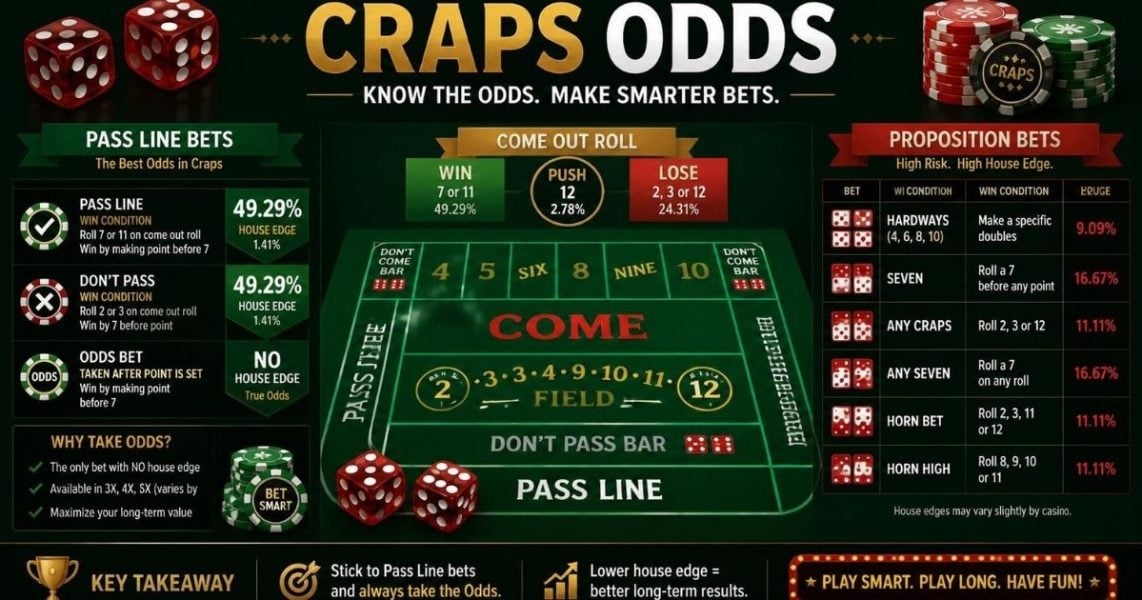
Craps odds vary hugely by bet. The pass line and come have a low house edge of about 1.41 percent, the don’t pass and don’t come 1.36 percent, and the free odds bet behind them has no house edge at all. The center proposition bets are the worst, costing up to nearly 17 percent.
Craps has some of the best odds in the casino and some of the very worst, often side by side on the same table. The difference between a smart craps bet and a poor one is enormous, from a house edge of zero on the free odds bet to nearly 17 percent on a one-roll proposition. This guide lays out the odds, payouts and house edge for every bet, with a chart and a calculator that shows how taking odds cuts your edge.
- The pass line edge is about 1.41 percent. That is among the lowest house edges anywhere in the casino.
- The free odds bet has no house edge. It is paid at true odds, which is unique on the casino floor.
- Odds pull your combined edge toward zero. Taking 3-4-5x odds drops it from 1.41 percent to about 0.37 percent.
- Edges climb fast on the other bets. Place, field and center bets cost several times more than the line.
What are the odds in craps?
Craps odds run across an unusually wide range. The lowest edge on the table is zero, on the free odds bet, and the highest is close to 17 percent on the worst center bets. In between sit the line bets near 1.4 percent, the place bets, and the field. This is why craps rewards knowing the numbers more than almost any other game: two bets sitting inches apart on the felt can cost you ten times as much.
All of it comes from the same source, the 36 ways two dice can land. A 7 appears on 6 of those 36 combinations, the 6 and 8 on 5 each, and so on down to a single way each for the 2 and the 12. Every payout and house edge in craps is built on those frequencies. Our craps bets guide explains what each bet is, while this page focuses on what each one costs, and our how to play craps guide covers the round itself.
The free odds bet and true odds
The single most important number in craps is zero, the house edge on the free odds bet. Once a point is set, you can back your line bet with odds that are paid at true odds: 2 to 1 on the 4 and 10, 3 to 2 on the 5 and 9, and 6 to 5 on the 6 and 8. Because the payout exactly matches the real probability of the point, the house makes nothing on this bet, which is unique in the casino.
This is why experienced players always take odds. It does not lower your expected loss on the line bet itself, since that is fixed, but it lets you put more money in play at no cost, which pulls your overall house edge down. The calculator below shows exactly how far.
Craps odds calculator
Choose a pass line bet and how much odds you take behind it, and the calculator shows your combined house edge on the total money in play. Watch it fall as you take more odds.
Craps payouts and house edge chart
This chart lists the payout and house edge for the main craps bets, from the cheapest to the most expensive. Use it as a quick reference at the table: anything above the place 6 and 8 is costing you real money.
| Bet | Payout | House edge |
|---|---|---|
| Pass line / Come | 1 to 1 | 1.41% |
| Don’t pass / Don’t come | 1 to 1 | 1.36% |
| Free odds on 4 or 10 | 2 to 1 (true odds) | 0% |
| Free odds on 5 or 9 | 3 to 2 (true odds) | 0% |
| Free odds on 6 or 8 | 6 to 5 (true odds) | 0% |
| Place 6 or 8 | 7 to 6 | 1.52% |
| Place 5 or 9 | 7 to 5 | 4.00% |
| Place 4 or 10 | 9 to 5 | 6.67% |
| Field | 1 to 1 (2 to 1 on the 2 and 12) | 2.78% to 5.56% |
| Big 6 or 8 | 1 to 1 | 9.09% |
| Any seven | 4 to 1 | 16.67% |
The pattern is clear: the line bets and the free odds behind them are cheap, placing the 6 or 8 is fine, and everything else costs several times more. For how to build those low edge bets into a full session, see our craps strategy guide.
The odds of rolling each number
Every craps number has a fixed frequency out of 36 possible dice combinations. A 7 comes up 6 times in 36, or about 16.7 percent, making it the most common roll. The 6 and 8 appear 5 times each, the 5 and 9 four times, the 4 and 10 three times, the 3 and 11 twice, and the 2 and 12 just once each. Those frequencies never change, which is exactly why no system can beat the game and why craps sits comfortably among the lowest house edge casino dice games.
Understanding the frequencies also explains the payouts: rarer numbers pay more because they are harder to hit. A place bet on the 4 pays 9 to 5 while a place bet on the 6 pays only 7 to 6, precisely because a 6 lands far more often than a 4.
Playing the low edge bets
The takeaway from the odds is simple: bet the pass line or don’t pass, back it with as much free odds as you can, and add a place 6 or 8 if you want more action. That keeps your house edge as low as craps allows. When you want to try it in Canadian dollars, choose a licensed site with table limits that suit you.