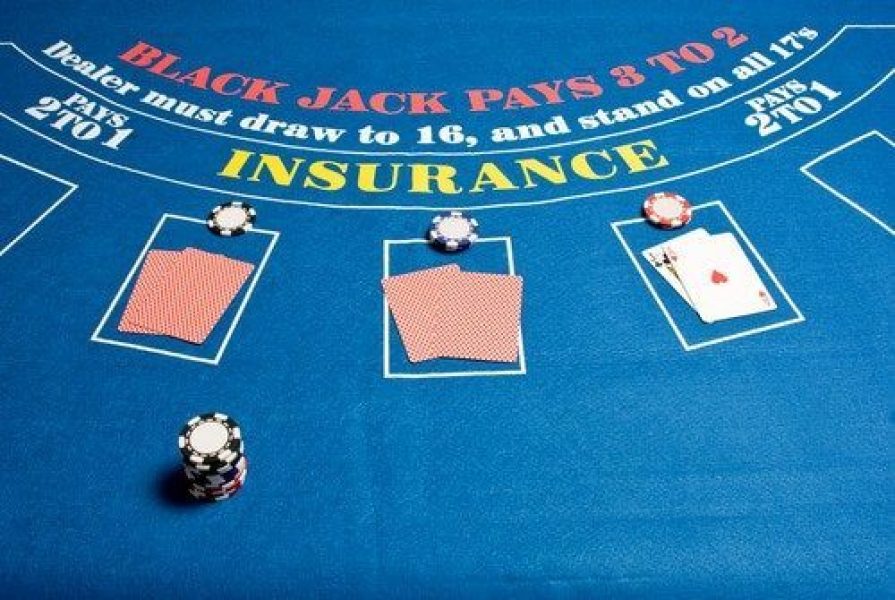
Blackjack insurance is a side bet, offered when the dealer shows an Ace, that the dealer has a natural blackjack. It pays 2 to 1, but the dealer holds blackjack less than a third of the time, so the bet carries a house edge of roughly 7%. For almost every player, the correct move is to decline it.
Blackjack insurance looks like protection, but it is one of the worst bets on the table. When the dealer shows an Ace, you are offered the chance to bet that they have blackjack. It sounds prudent, and casinos present it that way, but the maths is clear: over time it loses money faster than almost any other move in the game. This guide explains what blackjack insurance is, how it works, and the one narrow situation where it makes sense. It builds on our complete guide to blackjack.
- Insurance is a bet that the dealer has blackjack, offered only when their up card is an Ace, and it pays 2 to 1.
- It carries about a 7% house edge, because the dealer has blackjack less than one time in three.
- Basic strategy always says decline, even when you hold a blackjack yourself, where it appears as “even money”.
- The only exception is card counting, when a counter knows the shoe is unusually rich in ten value cards.
What is insurance in blackjack?
Blackjack insurance is an optional side bet offered only when the dealer’s up card is an Ace. You are betting that the dealer’s hidden hole card is a ten value card, which would give them a natural blackjack. It is called insurance because it is marketed as a way to protect your main bet against a dealer blackjack, but it is a separate wager with its own odds, not a refund.
You can stake up to half of your original bet on the insurance line. If the dealer turns out to have blackjack, the insurance bet pays 2 to 1, which covers the loss of your main bet. If the dealer does not have blackjack, you lose the insurance stake and play your hand as normal. Despite the reassuring name, it is simply a bet on the dealer’s hole card.
How does blackjack insurance work?
The offer appears before the dealer checks their hole card, so you decide with the same information the dealer has. Here is the sequence at the table.
- The dealer shows an Ace. Before play continues, insurance is offered to the table.
- You place up to half your bet on the insurance line, or decline and carry on.
- The dealer checks for blackjack. If they have it, insurance pays 2 to 1 and your main bet loses, so you break even overall. If they do not, you lose the insurance stake and play your hand.
Say you bet 20 dollars and take 10 dollars of insurance. If the dealer has blackjack, you lose the 20 dollar hand but win 20 dollars on insurance, breaking even. If they do not, you are down 10 dollars before your hand is even played out. That downside is why the bet costs you over time.
Should you take insurance in blackjack?
For almost everyone, no. The reason is a simple gap between the payout and the true odds. Insurance pays 2 to 1, which would be fair only if the dealer had blackjack one time in three. But with a full shoe, only about 4 in every 13 cards are ten valued, so the dealer completes blackjack roughly 31% of the time, less than the one in three you need. That gap is the house edge, and it works out to around 7%, more than ten times the edge on the main game.
Use the explorer below to see how the expected value of insurance changes with how many ten value cards remain. Notice that it only turns positive once more than a third of the remaining cards are tens, a situation an ordinary player has no way to know they are in.
What is “even money” in blackjack?
Even money is insurance in disguise. If you are dealt a natural blackjack and the dealer shows an Ace, the dealer may offer to pay you 1 to 1 straight away, rather than risk the hand pushing if they also have blackjack. Taking it feels safe, a guaranteed win instead of a possible tie.
But it produces exactly the same outcome as taking insurance on a blackjack, and it carries the same roughly 7% house edge. By declining even money, you occasionally push when the dealer also has blackjack, but the rest of the time you collect the full 3 to 2 payout, which is worth more over the long run. Basic strategy says decline even money too.
When is insurance ever worth taking?
There is exactly one situation where insurance becomes a good bet: when you know the remaining shoe holds more ten value cards than usual. As Wikipedia’s overview of the game notes, insurance is advantageous whenever the hole card has better than a one in three chance of being a ten, and card counting is how a player identifies those moments.
In practice that means a skilled card counter tracking a shoe that has gone rich in tens, usually at a true count of about plus three or higher. For everyone playing without a count, that information is simply unavailable, so the safe and correct default is always to say no. If you are not counting, there is no version of insurance that beats declining.