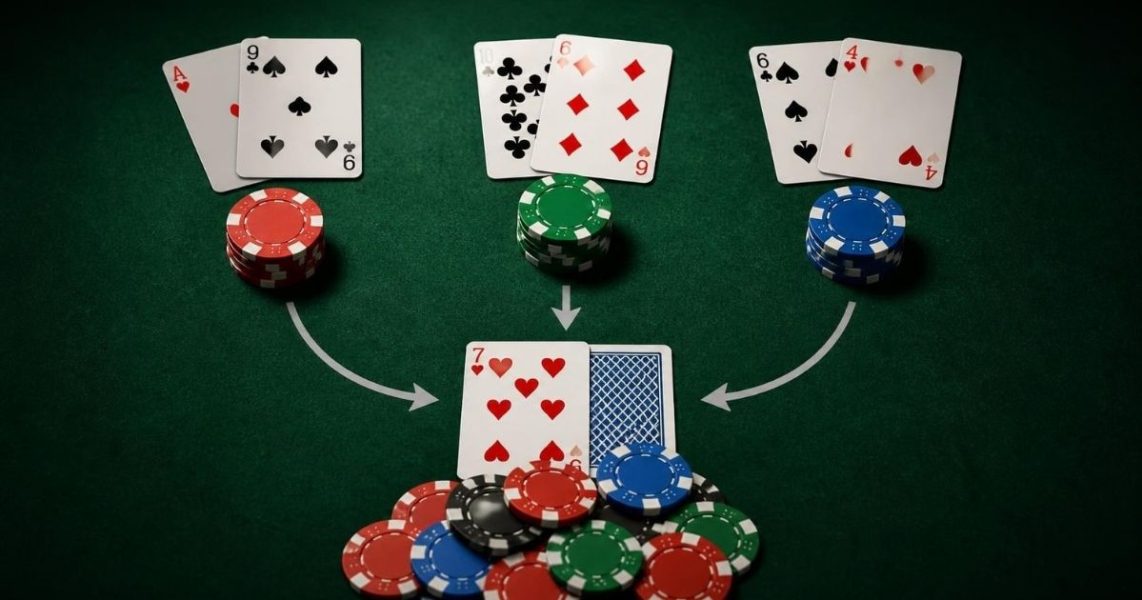
The house edge in blackjack is about 0.5% when you play basic strategy at a table paying 3 to 2. That is one of the lowest edges in the casino, which is why blackjack has some of the best odds on the floor. Poor rules raise it fast: a 6 to 5 payout alone adds roughly 1.4%.
Blackjack gives you better odds than almost any game in the casino, but only if you protect them. The house edge is the small mathematical advantage the casino keeps over time, and in blackjack that edge is unusually low. The catch is that the table rules, especially the payout, can quietly multiply it. This guide explains what the house edge in blackjack really is, the odds of winning a hand, and how each rule shifts the numbers, with a calculator to test any table. It builds on our complete guide to blackjack.
- The house edge is about 0.5% with basic strategy at a 3 to 2 table, among the lowest in the casino.
- A 6 to 5 payout adds about 1.4%, roughly tripling the edge. It is the single worst rule you can accept.
- Fewer decks and a dealer who stands on soft 17 both nudge the odds in your favour.
- Other players do not change your odds. A bad player at the table cannot cost you your long term edge.
What is the house edge in blackjack?
The house edge in blackjack is the percentage of each bet the casino expects to keep over the long run. At about 0.5% with basic strategy, it means that for every 100 dollars you wager across many hands, the house expects to keep around 50 cents. As GameSense explains, the house always holds a mathematical advantage, but in blackjack skilled play keeps that advantage as small as it gets.
That 0.5% figure assumes you play every hand correctly using our basic strategy chart. A typical player who relies on instinct hands the casino far more, often 2% or higher, simply through avoidable mistakes. The single biggest factor you control is not luck, it is playing correctly and choosing a table with fair rules.
What are the odds of winning a hand of blackjack?
On any single hand, a basic strategy player wins about 42% of the time, loses about 49%, and pushes the remaining 9% or so. That sounds like a losing split, and it would be, except that wins are worth more than losses cost. A natural blackjack pays 3 to 2, and doubles and splits let you put more money down when the odds favour you, which is what closes most of the gap.
The dealer is not unbeatable either. Because they must draw to 16 and stand on 17, the dealer busts roughly 28% of the time, and more often when showing a weak card of 4, 5 or 6. Understanding those dealer odds is what basic strategy is built on, and why you stand on stiff hands against a weak dealer card.
Blackjack house edge calculator
Table rules change the house edge more than most players realise. Set the rules below to see the approximate edge for that table, and what it costs on 100 dollars of bets.
The rules that change your blackjack odds
Not every blackjack table is equal. Four rules do most of the work, and knowing them lets you pick the best table in the room at a glance.
- Blackjack payout (3 to 2 vs 6 to 5): the biggest single factor. A 6 to 5 table pays less for a natural and adds about 1.4% to the house edge. Always look for 3 to 2.
- Dealer soft 17: a dealer who hits a soft 17 rather than standing adds about 0.2% in the house’s favour.
- Number of decks: fewer decks slightly favour the player, so a single or double deck game beats a six or eight deck shoe, all else equal.
- Double after split: being allowed to double after splitting is worth about 0.14% to you, so its absence costs you.
Do other players affect your odds?
No. This is one of the most stubborn myths in blackjack: the idea that a bad player at the table, especially at the last seat, ruins everyone’s odds by taking the card that would have busted the dealer. It feels true when it happens, but the maths does not support it.
Over the long run, another player’s decisions are as likely to help you as to hurt you. For every time a bad player takes the dealer’s bust card, there is another time they take a card that would have busted you, or one that leaves the dealer weaker. It evens out completely, and your expected value stays the same no matter how anyone else plays. Blaming the player next to you feels natural, but it does not change your correct strategy or your odds by a single percentage point.
Does blackjack have the best odds in the casino?
Played well, blackjack is at or near the top. Its roughly 0.5% house edge beats roulette, most table games and slots by a wide margin. Only a handful of bets, like the odds bet in craps or perfect video poker, rival it. For a game you can learn in an afternoon, nothing on the floor offers better value.
| Game | Typical house edge |
|---|---|
| Blackjack (basic strategy) | About 0.5% |
| Baccarat (banker bet) | About 1.06% |
| European roulette | About 2.7% |
| American roulette | About 5.26% |
| Slots | 2% to 10% or more |
The lesson is that blackjack rewards the effort of learning it. The games that ask nothing of you, like slots, quietly charge the most, while the skill based games return the most for players who put in the work.