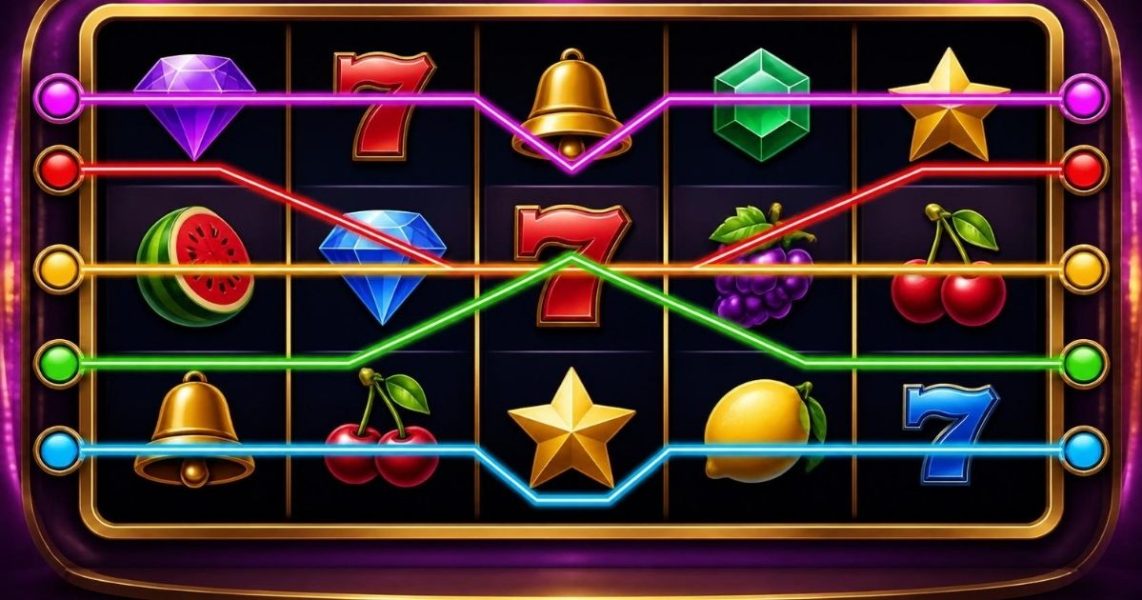
Slot machine paylines are the patterns across the reels that pay when matching symbols land on them. A slot can have one line or hundreds, and many modern games drop lines entirely for ways-to-win or cluster systems. More paylines does not mean better odds, because your stake is usually split across them.
The payline is the rule that decides whether a spin pays. It sounds simple, and on a classic three-reel game it is, but modern slots run anything from a single line to 243 ways or a cluster grid, and the paytable is where all of it is spelled out. Learn to read those two things and you can size up any slot in about thirty seconds. This guide shows you how, including the honest truth about playing more lines.
- A payline is a pattern across the reels that pays when matching symbols land on it.
- Ways to win drop the fixed patterns. Matching symbols pay on adjacent reels regardless of row.
- More lines is not better odds. You win more often but stake more, and many wins pay less than the spin cost.
- The paytable holds the detail. Symbol values, active lines and the RTP are all listed there.
What are slot machine paylines?
Slot machine paylines are the set patterns across the reels that pay out when matching symbols land along them. Classic slots had one line straight across the middle, while video slots added dozens or hundreds of patterns that zigzag, step and cross the grid, and a win only counts if the symbols sit on an active line.
Almost all modern slots also require wins to start on the leftmost reel and run on consecutive reels, so matching symbols on reels one, two and three pay while the same symbols on reels two, three and four usually do not. Which patterns are active, and how much each symbol pays, is decided by the game and resolved by the random number generator behind every spin, as our guide to how online slots work explains.
Paylines, ways to win and cluster pays
The easiest way to understand the different systems is to see them on a grid. Pick a system below, then step through the patterns to watch how each one forms a win on the same five by three layout.
Do more paylines mean better odds?
No. Playing more paylines makes wins land more often, but it does not improve your odds, because you are usually staking more per spin to cover them. A slot’s RTP stays the same whether you play one line or twenty, so the extra lines buy frequency, not value.
There is a catch worth knowing too. On multi-line slots a large share of those frequent wins pay back less than the spin actually cost, and research on Ontario machines found that most signalled wins on a fully covered nickel game were smaller than the wager. The lights and sounds say win, the balance says otherwise, which is why the number to watch is the one on screen rather than the celebration. Our guide to slot RTP covers what actually governs your return.
Ways to win and cluster pays
Ways to win systems scrap fixed patterns altogether: matching symbols pay whenever they land on adjacent reels from the left, whatever row they sit in. On a five by three grid that gives three positions on each of five reels, or 243 ways, and games that vary the symbols per reel push it far higher.
Cluster pays works differently again, paying when enough matching symbols touch each other in a group anywhere on the grid, usually with the winning cluster then disappearing so new symbols can drop in. The biggest ways-to-win format is Megaways, where the reel heights change every spin, which our Megaways guide covers in full. Whichever system a slot uses, the bonus features sit on top of it in the same way.
How to read a slot paytable
The paytable is the screen that spells out how a slot pays, and it is worth thirty seconds before you spin. Open it from the game’s menu or information button and you will find what each symbol is worth, how the lines or ways are arranged, what the special symbols do and, on licensed sites, the RTP.
Read it in this order: check the RTP and the paylines or ways count, then the symbol values, then the wild and scatter rules, and finally how the bonus round triggers. That tells you both what the game costs to cover and how volatile it is likely to feel, since a paytable with one huge top prize and little in between signals a bumpy ride. In Ontario the standards require this information to be available in a single click at all times.
Where to play slots in Canada
Once you can read the lines and the paytable, choosing a slot gets much easier: check how many lines or ways the game uses, what covering them costs per spin, and whether the RTP and volatility suit your budget. Then stick to a licensed site and set a limit before you play.