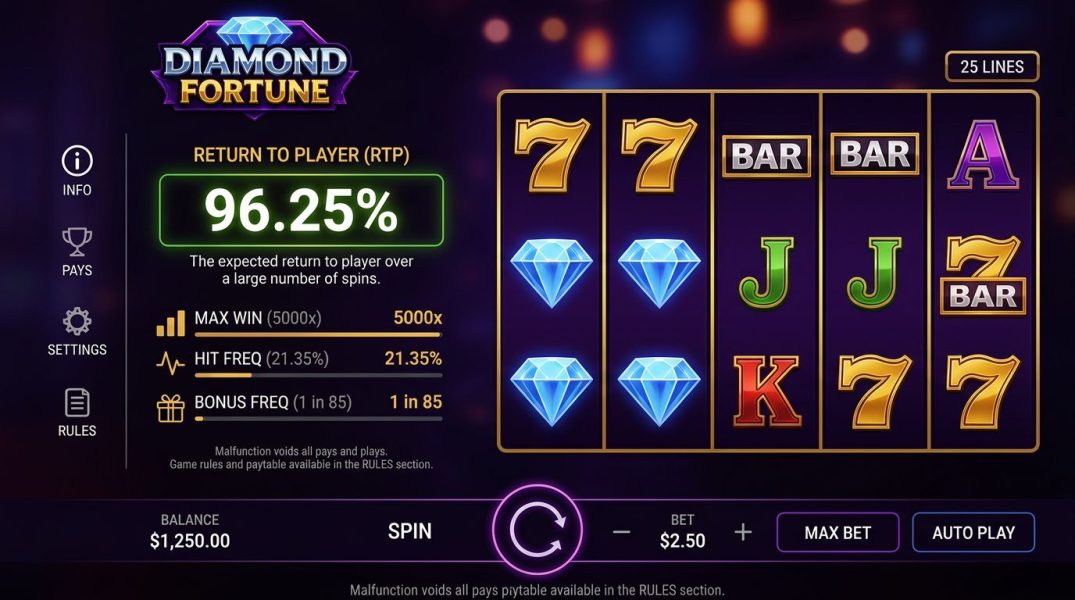
RTP, or return to player, is the percentage of all money bet on a slot that it pays back over the long run. A 96 percent RTP slot returns about C$96 for every C$100 wagered across millions of spins. It is a long-term average, not a guarantee for any single session.
RTP slot figures are the most quoted numbers in the game, and the most misunderstood. Return to player tells you how a game pays over millions of spins, not what will happen tonight. Get that distinction right and RTP becomes useful for choosing games; get it wrong and it sets you up for disappointment. What the figure really means, what counts as a good one, why the same slot can pay differently at two casinos and why your session will almost never match it are all below.
- RTP is the share of all bets a slot pays back over the long run. The rest is the house edge.
- It is a long-run average, not a session promise. Over a short session you can win big or lose the lot.
- A good RTP is generally 96 percent or above. Most slots sit between 94 and 97 percent.
- RTP is separate from volatility. One is how much comes back, the other is how bumpy the ride is.
What is RTP in slots?
RTP, short for return to player, is the percentage of all the money bet on a slot that the game pays back to players over the long run. A slot with a 96 percent RTP returns about C$96 for every C$100 wagered across millions of spins, and the remaining 4 percent is the house edge that keeps the casino in business.
That figure is set by the game maker and baked into the maths of the game, decided spin by spin by the same random number generator behind every result, which our guide to how online slots work covers. RTP and house edge are just two ways of describing the same split: a 96 percent RTP is a 4 percent house edge, and the two always add up to 100.
What does a slot’s RTP really mean?
An RTP is a long-run average measured over millions of spins, not a promise for your session, which is the single most important thing to understand about it. Over a short session you might get back double what you staked or nothing at all, and both outcomes are completely normal on a 96 percent slot.
The reason is that RTP only reveals itself across an enormous number of spins. Because every result comes from a certified generator, as we cover in are online slots rigged, short runs swing wildly around the average before settling toward it. The simulator below shows exactly how that works.
What is a good RTP slot?
A good slot RTP is generally 96 percent or above, with most online slots falling between 94 and 97 percent. Anything at or above 96 percent is considered player-friendly, while games below about 94 percent hand the house a noticeably larger edge, and some progressive jackpot slots run lower still to help fund their prize pools.
RTP is a useful way to compare games, but chasing the very highest figure matters less than people think, because volatility and your budget shape a session far more than a single percentage point of RTP. If you do want the strongest headline numbers, our list of the highest payout casinos gathers higher-RTP options for Canadian players.
A few well-known games show where the benchmarks sit. The figures below are the providers’ published base RTPs for the standard version of each game; Mega Joker only reaches its headline number when you play its supermeter mode at the maximum bet.
| Slot | Provider | Published RTP | Where it sits |
|---|---|---|---|
| Mega Joker | NetEnt | 99.00% (supermeter, max bet) | Highest of the mainstream slots |
| Blood Suckers | NetEnt | 98.00% | Exceptional |
| Book of Dead | Play’n GO | 96.21% | Good, the typical benchmark |
| Starburst | NetEnt | 96.09% | Good |
| Typical progressive jackpot slot | Various | 88% to 94% | Low, the jackpot is funded from the gap |
Variable RTP: why one slot can pay differently at two casinos
The published RTP is no longer the whole story, because most large providers now release each slot in several builds with different returns and let the casino choose which one to run. A Pragmatic Play title might exist at 96.5, 95.5 and 94.5 percent, and a Play’n GO game at 96, 94 and 91 percent, all with identical reels, features and artwork. Nothing on screen tells you which build you are on except the figure in the game’s own information panel.
That makes the review-site figure a starting point and the in-game figure the one that counts. Two Canadian casinos can offer the same slot four or five percentage points apart, which is a bigger gap than the difference between a good and a poor game, so checking the panel at the casino you actually play at is the one RTP habit that pays for itself.
RTP versus volatility
RTP and volatility are two different measurements, and confusing them is a common mistake. RTP is how much a slot returns over the long run, while volatility is how bumpy the ride to that average is, so two slots can share the same 96 percent RTP and still feel nothing alike.
A low volatility slot pays small wins often, a high volatility slot pays rarely but larger, and both can land on exactly the same RTP. If you want the full picture of how those swings work, our guide to slot volatility explains it, and reading the two numbers together tells you almost everything about how a game will treat your bankroll.
How to check a slot’s RTP
You can usually find a slot’s RTP in its information or paytable screen, listed as a percentage in the game rules. It is worth a quick look before you play, especially because the figure can vary between different versions of the same game.
In the regulated markets that is a requirement, not a courtesy: the AGCO’s standards oblige every AGCO-registered Ontario casino to make each game’s theoretical RTP and rules available to the player from the game itself, and AGLC-registered Alberta casinos follow the same disclosure model; our guide to slot paylines and paytables shows what else that screen tells you. Wherever you play, stick to a licensed casino and pick a game whose RTP and volatility both suit your budget.