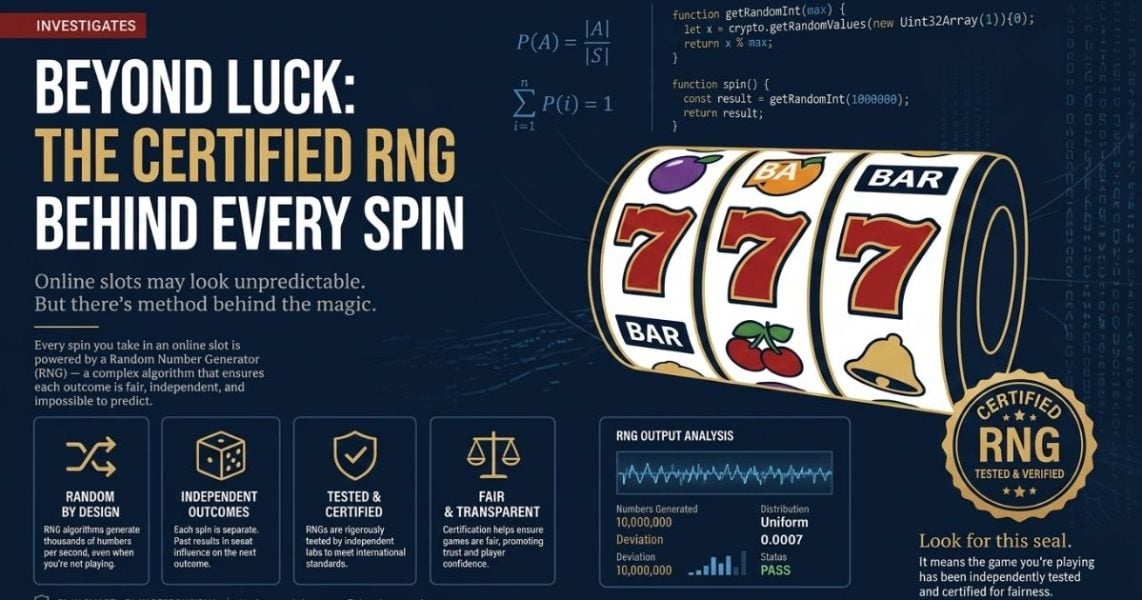
No, licensed online slots are not rigged. Every spin is decided by a random number generator that is independently tested and certified, and operators are regulated to prevent tampering. Slots do have a built-in house edge, disclosed as the RTP, but individual results are genuinely random and cannot be fixed for or against you.
The house has an edge, but the game is not cheating you. Those two facts sound contradictory, and confusing them is why so many players believe slots are rigged. A licensed slot is genuinely random on every spin, checked by independent labs and regulators, while still keeping a small disclosed advantage over time. This guide separates real fairness from the myths, and explains why a slot is never due to pay.
- Licensed online slots are not rigged. Every spin is decided by a certified random number generator.
- Slots have no memory. They are never due to pay, and never run hot or cold.
- There is a house edge, shown as the RTP. It is disclosed openly, not hidden by fixing spins.
- Nothing you do changes a spin. Not timing, not stopping the reels, not any betting system.
Are online slots rigged?
No, licensed online slots are not rigged. Every result is produced by a random number generator that is independently tested and certified for fairness, and the operators running the games are regulated to prevent tampering. What slots do have is a built-in house edge, but it is disclosed openly as the RTP rather than hidden by fixing individual spins.
The confusion usually comes from mixing up two different things: a fair game and a game you are guaranteed to win. Slots are fair in that every spin is genuinely random within published odds, but those odds still favour the house over time, exactly as our guide to return to player explains. That is not rigging, it is the disclosed maths of the game.
How online slots stay fair
Online slots stay fair through a chain of independent checks: a certified random number generator, third-party testing labs, and government regulators. The random number generator, or RNG, picks each outcome the instant you spin, as our guide to how online slots work describes, and slots have worked this way since the technology was first patented decades ago.
Before a slot goes live at a licensed casino, its RNG is audited by independent testing houses such as eCOGRA or iTech Labs, and regulators like Ontario’s AGCO require that certification along with published odds. So the game is not simply claimed to be fair, it is checked by parties with no stake in whether you win or lose.
Why slots can feel rigged
Slots feel rigged because of one stubborn illusion: that a long run without a win means a payout is due. It is not. A slot has no memory, so a losing streak does nothing to improve the next spin, which is exactly as likely to win as the very first one. Believing otherwise is the gambler’s fallacy, and it is the root of most rigging myths.
The same illusion powers the ideas that a slot runs hot or cold, that certain times of day pay better, or that a machine is owed after a big jackpot. None of it is true, because every spin is independent. Try it for yourself below: rack up a losing streak and watch the odds on the next spin refuse to budge.
Does stopping the reels or playing faster change anything?
No. The outcome of a spin is locked in the instant you press the button, before the reels finish moving, so stopping them early only speeds up the animation and never changes the result. There is no skill or timing in when a slot lands.
Playing faster or slower does not change your odds either, since each spin is independent and the RTP is fixed. Slowing down does mean you stake less money per hour, which is easier on your bankroll and a sensible habit, but it does not make a win any more likely. How wins actually form on the reels is covered in our guide to slot paylines, and none of it can be influenced by how or when you spin.
Can you beat online slots or make money from them?
Not in the long run. Because every spin is random and independent, and the house edge is baked into the RTP, no system, timing trick or betting pattern can shift the odds in your favour. You can absolutely win in the short term through luck, sometimes a lot, but there is no method that turns slots into a reliable profit.
The wild swings between wins and losses are just volatility at work, not a system paying off, and treating them as anything more is how people talk themselves into chasing losses. The healthiest way to see slots is as paid entertainment: set a budget you are happy to lose, and treat any win as a bonus rather than a plan.