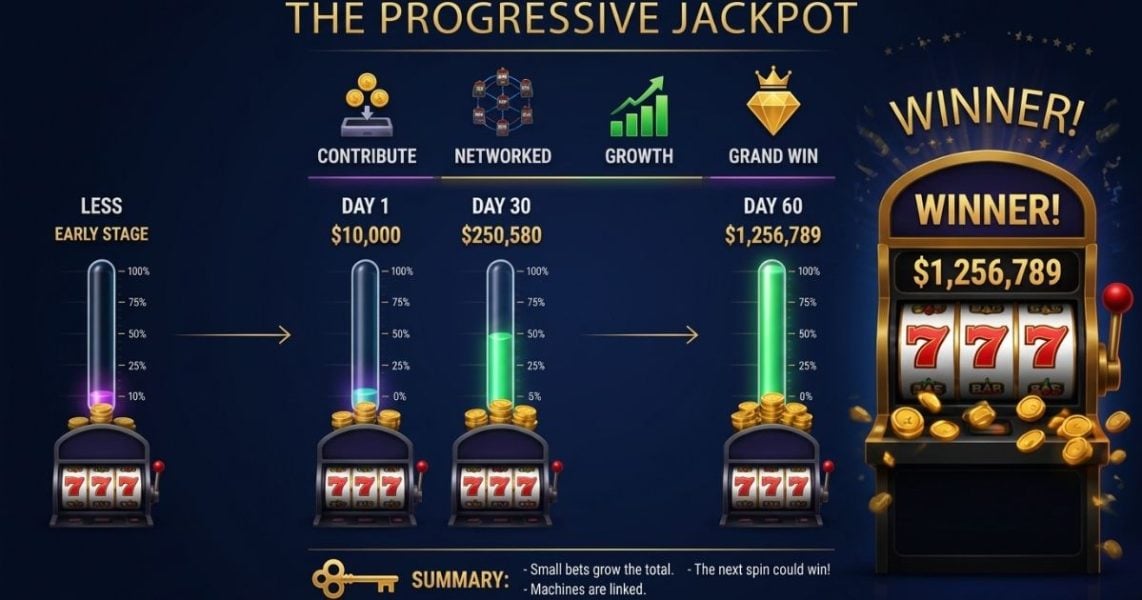
A progressive jackpot is a prize that grows every time the game is played without being won. A small share of each bet feeds the pool, so it climbs until someone hits it, then resets to a set starting amount. The odds of winning one are extremely long, often millions to one.
A progressive jackpot is the reason a slot can pay out millions. Instead of a fixed top prize, a slice of every bet placed across a game or a whole network of games feeds one pool that keeps climbing until somebody wins it. It is a genuinely clever design, and it comes with two catches worth understanding before you chase one: the odds are astronomical, and the money has to come from somewhere.
- A share of every bet feeds the pool. The prize grows until it is won, then resets to a seed amount.
- Networked jackpots grow fastest and pay biggest, because players across many casinos all feed the same pool.
- The odds are extremely long. Top-tier jackpots are often tens of millions to one on a single spin.
- The jackpot is funded from the base game. Progressive slots usually have a lower everyday RTP as a result.
What is a progressive jackpot?
A progressive jackpot is a prize pool that increases every time the game is played and the jackpot is not won. A small percentage of each qualifying bet, typically a low single-digit share, is diverted into the pool, so the total climbs continuously until someone triggers it, at which point it resets to a predetermined seed amount and starts building again.
That is the whole difference from an ordinary slot. A standard game pays a fixed top prize set by its paytable, while a progressive keeps a running total that no one can predict, funded by everyone playing. Underneath, the game still runs on the same random number generator as any other slot, as our guide to how online slots work explains.
How do progressive jackpots work?
Progressive jackpots work by pooling contributions, and how big and how fast the prize grows depends on how many games feed it. There are three common structures, plus multi-tier setups that combine small frequent prizes with one huge one.
| Type | Fed by | Growth | Typical size |
|---|---|---|---|
| Standalone | One game only | Slowest | Smallest, best odds |
| Local | Games at one casino | Moderate | Five to six figures |
| Networked | Players across many casinos | Fastest | Millions, longest odds |
Many progressive slots also run tiers, often labelled Mini, Minor, Major and Grand. The small tiers hit frequently and pay modestly, while the Grand is the headline prize with by far the longest odds. The jackpot itself is usually triggered either by a rare symbol combination or by a random bonus round, and on some games only a maximum qualifying bet is eligible, which is always worth checking in the paytable before you spin.
The odds of hitting a progressive jackpot
Jackpot odds are long in a way that is genuinely hard to picture, so the explainer below turns them into something concrete: how long a typical jackpot would take to land at the rate people actually play.
Do progressive slots have a lower RTP?
Usually yes, in the part of the game you actually play most. The money feeding the jackpot has to come from somewhere, and it comes out of the base game, so progressive slots typically return less on ordinary spins than a comparable non-progressive title. The overall figure still counts the jackpot, but that portion is locked inside a prize almost nobody wins.
This is the honest way to read a progressive’s headline RTP: a slice of it is theoretical, sitting in a pool waiting for one spin in tens of millions. Day to day you are playing a leaner game in exchange for a lottery ticket, which is a fine trade if that is what you want from it. Our guide to slot RTP covers how the number is built, and progressives are naturally the most extreme example of high volatility you will find.
Can you improve your chances of winning a jackpot?
Not meaningfully. The trigger is random on every spin, so there is no timing, pattern or system that brings a jackpot closer, and a game that has not paid in months is no more due than one that paid yesterday. The only real levers are choosing a tier with shorter odds and making sure your bet qualifies at all.
Two practical points do matter. Some progressives only pay the top prize on a maximum qualifying bet, so check the paytable or you could hit the combination and miss the prize. And a few networked games publish a must-drop ceiling, a figure the jackpot cannot exceed, which slightly improves the value of playing when the meter sits near it, though the odds on your individual spin never change. Beyond that it is chance, and the same fairness rules apply as to any slot, as our guide to whether online slots are rigged explains.
Where to play progressive jackpot slots in Canada
If you want to play for a jackpot, treat it as a lottery ticket rather than a strategy: pick a licensed site, set a budget you are happy to lose, and check the qualifying bet before you spin. That way the fun of the chase does not turn into a bigger loss than you planned.