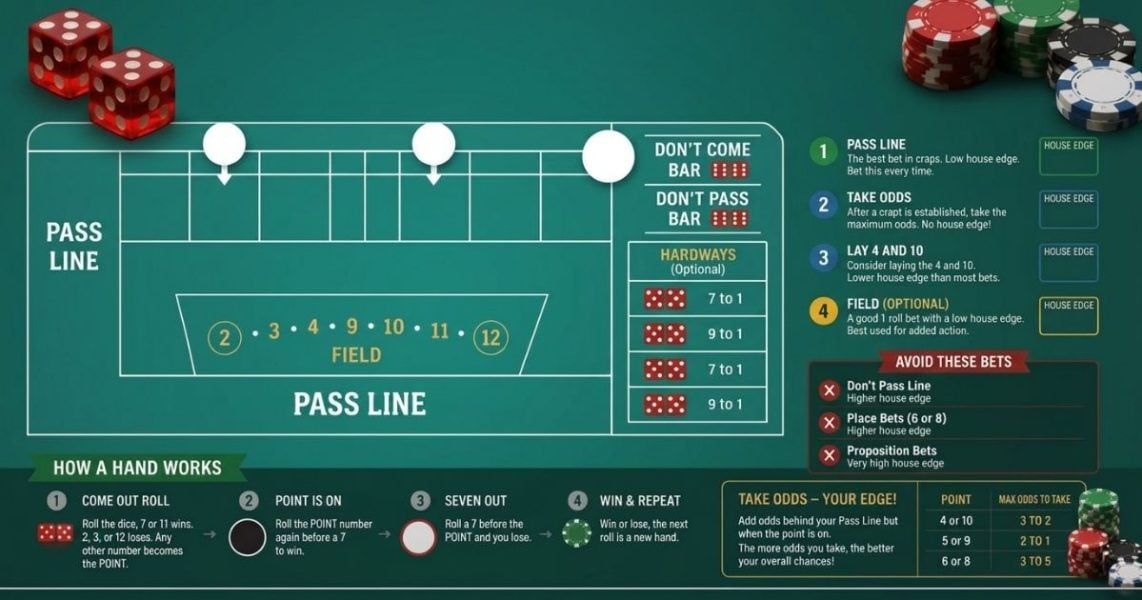
The only real craps strategy is bet selection and discipline. Back the pass line or don’t pass, take maximum free odds, and set a firm budget. No betting system, from the Martingale to the iron cross, changes the house edge, because the dice have no memory. Systems only reshape how you win and lose.
Search for a craps strategy and you will find endless systems promising to beat the game. None of them do. The house edge on each bet is fixed, so no pattern of wagers can turn it in your favour, and this guide is honest about that. What it offers instead is what actually helps: the bets worth making, the discipline that makes a bankroll last, and a simulator you can run yourself to see why systems fail.
- Bet selection is the strategy. The pass line, don’t pass and free odds carry the lowest house edge on the table.
- No system beats the dice. Every roll is independent, so no betting pattern can change the house edge.
- Progressions are a trap. The Martingale and its kind swap many small wins for rare, total wipeouts.
- Discipline is what you control. A set budget with stop-loss and win limits keeps the game affordable.
Is there a winning craps strategy?
No, and it is worth being blunt about it. Craps is a game of fixed probabilities: the dice land the same way every roll, whatever happened before, so no sequence of bets can give you a long-term advantage. Any site promising a guaranteed winning system is selling a fantasy.
That does not mean strategy is pointless. It means real strategy is about two things you can control: which bets you make, and how you manage your money. Get those right and you will lose less and play longer than someone chasing systems. The house still keeps its edge, as our craps odds guide sets out bet by bet, but you can make it as small as the game allows. If you are new to the game, start with our how to play craps guide.
The best craps strategy: low edge bets and odds
If a craps strategy exists, this is it: bet the pass line or don’t pass, then back it with the maximum free odds the table allows. The line bets carry a house edge of just 1.36 to 1.41 percent, and the odds bet behind them has no house edge at all, which drags your overall cost down toward a fraction of a percent. There is no cheaper way to play.
If you want more numbers in action, place the 6 or 8, the best of the box bets at 1.52 percent, and leave everything else alone. The field, the Big 6 and 8, and the center proposition bets all cost several times more, as our craps bets guide lays out. Sticking to the cheap bets is not caution, it is simply the correct play.
Bankroll and betting discipline
With the bets chosen, the rest of good craps play is money management, and this is where discipline beats cleverness. Bet flat: pick a unit you are comfortable with, ideally a small fraction of your session bankroll, and keep it steady. Flat betting will not win you money, but it protects you from the fast losses that chasing bets causes.
Set your limits before you start, not in the heat of a cold streak. Decide how much you are willing to lose and walk away when you reach it, and set a win goal so you actually pocket a good run instead of giving it back. Treat craps as entertainment with a price, never as income. That mindset, more than any system, keeps the game enjoyable and affordable.
Do craps betting systems work?
Betting systems are where most craps strategy talk goes wrong. Progressions like the Martingale, where you double your bet after each loss to recover it, feel foolproof. In reality they change nothing about the house edge. They only reshape your results: many small wins, then an occasional catastrophic loss when a losing streak outlasts your bankroll or hits the table limit.
The same is true of the popular craps systems by name. The iron cross covers almost every number but loses everything on a 7 and carries a high combined edge. The 3-point molly, the regression, the classic dark side systems and the rest all rearrange your bets without lowering their cost. None of them beat a plain pass line bet with odds. You do not have to take our word for it: the simulator below plays thousands of sessions and shows what each approach really does to your money.
Craps betting system simulator
This plays 5,000 sessions of pass line betting at the settings you choose, and reports what happened across all of them. Compare flat betting with the Martingale and watch the average loss stay close to the house edge, while the wipeout rate tells the real story.
Dice control and the gambler’s fallacy
The other pillar of craps folklore is that a skilled shooter can influence the dice, through dice setting or a controlled throw. It is a seductive idea, but the dice are made to bounce off textured walls precisely so the outcome cannot be steered, and no study has shown a repeatable edge. Treat dice control as a myth, not a strategy.
Just as common is the belief that a number is due, that a long gap without a 7 makes it more likely soon. This is the classic gambler’s fallacy. Each roll is independent of the last, so the dice are never due for anything, and chasing that feeling only leads to bigger bets on worse hunches. Past rolls tell you nothing about the next one.
Playing craps the smart way
Sound craps strategy is refreshingly simple: bet the pass line, take maximum odds, place the 6 or 8 if you want more, and set your limits before you play. It will not make you a winner, because nothing can, but it makes the game last longer and cost less. When you want to put it into practice, choose a licensed site that lets you start at low stakes in Canadian dollars.