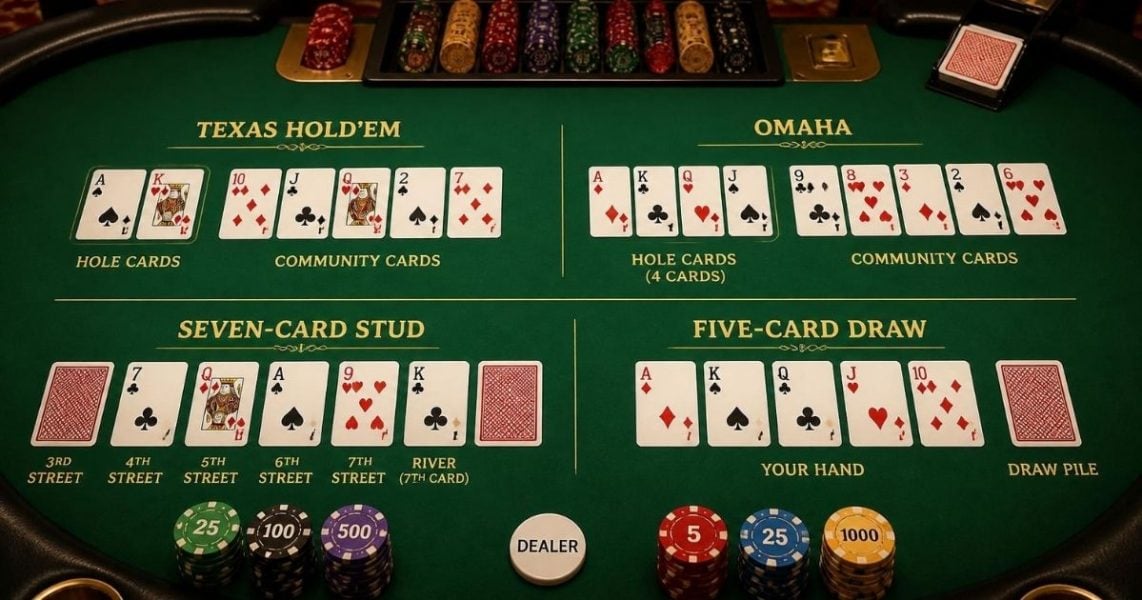
The main types of poker fall into four groups. Community card games like Texas Hold’em and Omaha share face-up cards; stud games like seven-card stud mix face-up and face-down cards; draw games like five-card draw let you swap cards; and casino table games like Caribbean Stud pit you against the house. All use the same hand rankings.
Poker is not one game but a whole family of them, and while Texas Hold’em dominates today, there are dozens of variants worth knowing. The good news is that they almost all share the same hand rankings, so once you learn one, the rest come quickly. This guide maps out the main types of poker by how the cards are dealt, from the community card giants to the casino table games, and helps you find one to start with. It builds on our complete guide to poker.
- Four broad families. Community card, stud, draw and casino table games cover nearly every poker variant you will meet.
- Same rankings throughout. The hand rankings barely change between variants, so learning them once covers most games.
- Hold’em is the easiest start. Texas Hold’em is the most popular and the simplest entry point for a beginner.
- Casino games differ. Caribbean Stud and similar games are played against the dealer, not other players.
The main types of poker
The simplest way to make sense of the different types of poker is to group them by how the cards are dealt. Nearly every variant falls into one of four families, and knowing which family a game belongs to tells you most of what you need to expect at the table.
| Family | How it works | Best-known games |
|---|---|---|
| Community card | Shared face-up cards combine with your hidden cards | Texas Hold’em, Omaha |
| Stud | A mix of face-up and face-down cards, no shared board | Seven-card stud, five-card stud |
| Draw | A full hidden hand you improve by swapping cards | Five-card draw |
| Casino table | House-banked games played against the dealer | Caribbean Stud, Three Card Poker |
The first three are the classic player-versus-player families, where you compete for a pot against other people. The fourth, casino table poker, is a different animal: you play against the house for fixed payouts, more like blackjack than a poker tournament. We will look at each in turn.
Community card poker
Community card games are the most popular type of poker today, and the ones you are most likely to find online or on television. In these games each player gets a few private hole cards, and shared community cards are dealt face up in the middle for everyone to use. You make your best hand by combining the two.
- Texas Hold’em. Two hole cards and five shared cards. The most popular poker game in the world and the easiest to learn, covered fully in our Texas Hold’em rules guide.
- Omaha. Four hole cards, but you must use exactly two of them plus three from the board. Bigger hands and busier pots, explained in our Omaha poker guide.
If you are new to poker, this is the family to start with, and Hold’em specifically. It is the most documented, the most available, and the simplest to follow, which is why nearly every beginner learns it first.
Stud poker
Stud poker is the older style that dominated before Hold’em took over. There are no shared community cards; instead each player is dealt their own mix of face-up and face-down cards across several betting rounds. Because some of everyone’s cards are visible, memory and observation matter more than in community games.
Seven-card stud is by far the most common form, where each player ends up with seven cards, three hidden and four exposed, and makes their best five-card hand. Five-card stud is the simpler, older cousin. Stud rewards players who track the exposed cards carefully, since you can see much of what your opponents are holding, which changes the odds on every street.
Draw poker
Draw poker is the style most people picture from old films and home games. Each player is dealt a complete hand, hidden from everyone else, and then has the chance to discard some cards and draw replacements to improve it. There are no exposed or shared cards at all.
Five-card draw is the classic and the simplest, making it a good introduction to how betting works without a board to read. It is rarely spread in casinos now, but it remains a staple of casual home games because the rules are so easy to pick up. The lack of shared information makes it a game of pure bluffing and bet-reading.
Poker variant explorer
With so many games to choose from, it helps to filter them. Use the controls below to narrow the field by family, by who you play against and by how easy the game is to learn, and see which variants match.
Casino table poker games
Casino table poker games look like poker but play very differently: you are not competing against other players for a pot, you are playing against the dealer for fixed payouts, much like blackjack. They are quick to learn, purely for casino play, and carry a built-in house edge, so they reward knowing the rules before you sit down.
- Caribbean Stud. A five-card game against the dealer. You place an ante, see your cards, then either fold or raise. The dealer needs a qualifying hand, and payouts scale with your hand’s strength.
- Three Card Poker. Played with just three cards each, against the dealer. Fast, simple, and popular for its bonus payouts on strong hands.
- Red Dog. A simple betting card game sometimes grouped with poker. You bet on whether a third card will fall between two dealt cards. It is easy but not true poker, as there are no poker hands involved.
These games suit players who want the feel of a poker table without learning to read opponents. Because the house edge is fixed, the main skill is knowing the correct basic decisions and choosing games with reasonable odds. You can play many of them with a real dealer at a live casino.
Easy poker games for beginners
If you are just starting out, some poker games are far friendlier than others. The easiest games have simple rules, few cards to track, and plenty of free tables to practise on. Based on how quick each is to learn, here are the best starting points.
- Texas Hold’em. The top pick. Just two hole cards to manage, huge amounts of learning material, and beginner tables everywhere.
- Five-card draw. No board and no exposed cards, so the rules are minimal. A great way to learn betting in a home game.
- Three Card Poker. If you prefer playing the house, three cards and a simple decision make it one of the easiest casino poker games.
Whichever you choose, start on play-money or low-stakes tables. The single fastest way to learn any variant is to play plenty of hands to showdown, where the rules and rankings quickly become second nature. From there, the odds and strategy in our poker odds guide are the natural next step.
The most popular poker games
While there are dozens of variants, a handful account for most of the poker played worldwide. If you want to focus your time, these are the games that will get you into the most tables, online and off.
- Texas Hold’em. The undisputed number one, and the standard game in casinos, online rooms and tournaments everywhere.
- Omaha. The clear second, especially Pot-Limit Omaha, popular for its action and big draws.
- Seven-card stud. Once the most popular game in the world, still widely played and a staple of mixed games.
- Caribbean Stud and Three Card Poker. The most common poker-style games at the casino tables, for players who want to face the house.
Learn Hold’em first, add Omaha when you want more action, and you will be equipped for the vast majority of poker you will encounter. The specialist games are worth exploring once the fundamentals feel solid.
Playing different poker games in Canada
Online poker rooms give Canadians the widest choice of variants, from Hold’em and Omaha cash tables to the occasional stud or draw game, usually with play-money versions to learn on. For the casino table games, live dealer studios stream Caribbean Stud, Three Card Poker and more with a real croupier, so you get the atmosphere of a casino floor from home.