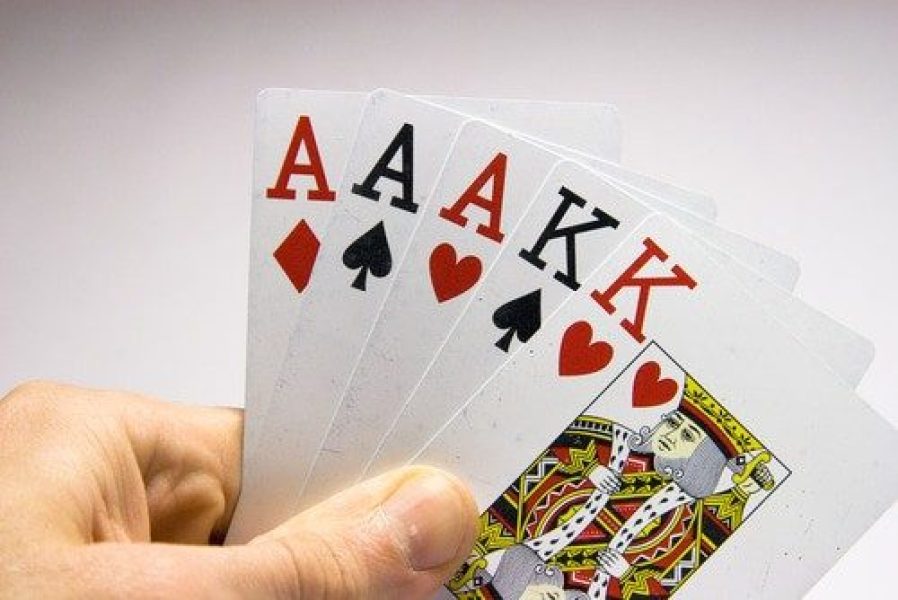
Omaha poker is a community card game like Texas Hold’em, but each player gets four hole cards instead of two. The key rule: you must use exactly two of your four hole cards plus exactly three of the five community cards to make your hand. Play runs over the same four betting rounds, and it is most often played pot-limit, known as PLO.
Omaha poker is the natural next game to learn after Texas Hold’em, and its four hole cards make for bigger hands and livelier pots. It looks almost identical to Hold’em at the table, but one rule changes everything: you must use exactly two of your four cards and exactly three from the board. Get that right and the rest follows quickly. This guide covers Omaha Hi, Omaha Hi-Lo, the betting and a hand builder to practise, building on our complete guide to poker.
- Four hole cards, not two. Omaha deals each player four private cards, which is the main difference from Hold’em.
- Exactly two plus three. You must use two hole cards and three community cards, no more and no less.
- Usually pot-limit. The most common form is Pot-Limit Omaha, or PLO, where the pot caps the bet size.
- Same rankings, same rounds. The hand rankings and the four betting rounds match Hold’em exactly.
What is Omaha poker?
Omaha poker is a community card game that grew out of Texas Hold’em. Each player is dealt four private hole cards, and five community cards are dealt face up in the middle across the same four betting rounds you find in Hold’em. The goal is the same too: make the best five-card poker hand, or bet enough that everyone else folds.
The plentiful cards make Omaha a game of big draws and strong hands, which is why pots tend to be larger and the action busier than in Hold’em. It is most commonly played as Pot-Limit Omaha, often shortened to PLO, and it uses the standard poker hand rankings. If you already know Hold’em, you are most of the way there, as our Texas Hold’em rules guide explains the shared structure.
The two-and-three rule
The single most important rule in Omaha, and the one that catches out every Hold’em player, is this: you must use exactly two of your four hole cards and exactly three of the five community cards. Not one, not three, exactly two from your hand, every time. In Hold’em you can use any mix, even playing the board, but in Omaha the two-and-three split is fixed.
This trips people up constantly. If four hearts are showing on the board and you hold a single ace of hearts, you do not have a flush, because you can only use one heart from your hand and must use exactly two hole cards. You would need two hearts in your hand to make the flush. Keeping the two-and-three rule in mind changes how you read every hand.
Omaha hand builder
The best way to lock in the two-and-three rule is to build a hand yourself. Pick exactly two of your four hole cards and exactly three of the five board cards, and the builder shows the five-card hand you have made. Try to make a flush with only one suited hole card and you will see why it does not work.
Omaha vs Texas Hold’em
Omaha and Hold’em share their structure, so the differences are easy to summarise. If you know one, learning the other is mostly about the card counts and the two-and-three rule.
| Feature | Omaha | Texas Hold’em |
|---|---|---|
| Hole cards | Four | Two |
| Cards you must use | Exactly 2 hole + 3 board | Any 5 of the 7 |
| Most common format | Pot-Limit (PLO) | No-Limit |
| Betting rounds | Four (preflop, flop, turn, river) | Four (preflop, flop, turn, river) |
| Hand rankings | Standard | Standard |
Because you always have four cards to work with, strong made hands and big draws are far more common in Omaha, so a hand that would win in Hold’em is often second best here. That makes hand reading and the odds of drawing out even more important than they are in Hold’em.
Omaha Hi and Omaha Hi-Lo
Omaha comes in two main forms. The standard version, where the highest hand wins the whole pot, is called Omaha Hi. The split-pot version is Omaha Hi-Lo, also written Omaha 8 or Better, where the pot is shared between the best high hand and the best qualifying low hand.
- Omaha Hi. The best five-card high hand wins the entire pot, exactly like Hold’em. This is the most common form and the one most people mean by Omaha.
- Omaha Hi-Lo. Half the pot goes to the best high hand and half to the best low hand, provided a low of eight or lower is possible. The two-and-three rule still applies to each.
For a beginner, Omaha Hi is the place to start, since it works just like the Hold’em you already know but with four cards. Hi-Lo adds the extra layer of chasing both halves of the pot at once, which is best left until the basic game feels comfortable.
Omaha betting and the blinds
The betting in Omaha works exactly as it does in Hold’em. Two players post the small and big blinds, everyone is dealt their cards, and play proceeds clockwise through four betting rounds. The game is named by its blinds, so a CA$1/CA$2 Omaha game has a CA$1 small blind and a CA$2 big blind.
The one thing worth understanding is the pot-limit format that defines PLO. Unlike No-Limit, where you can bet everything at any time, in Pot-Limit Omaha the maximum bet is the current size of the pot. That caps how fast a pot can grow, but with four-card hands the pots still build quickly. Sound bankroll management matters here because the swings can be large.
Playing Omaha poker in Canada
Omaha is widely available at online poker rooms, usually as Pot-Limit Omaha, and many sites let you practise on play-money tables first. That is the ideal way to drill the two-and-three rule until reading your best hand becomes automatic. Live dealer tables are less common for Omaha than Hold’em, but the online game is easy to find.