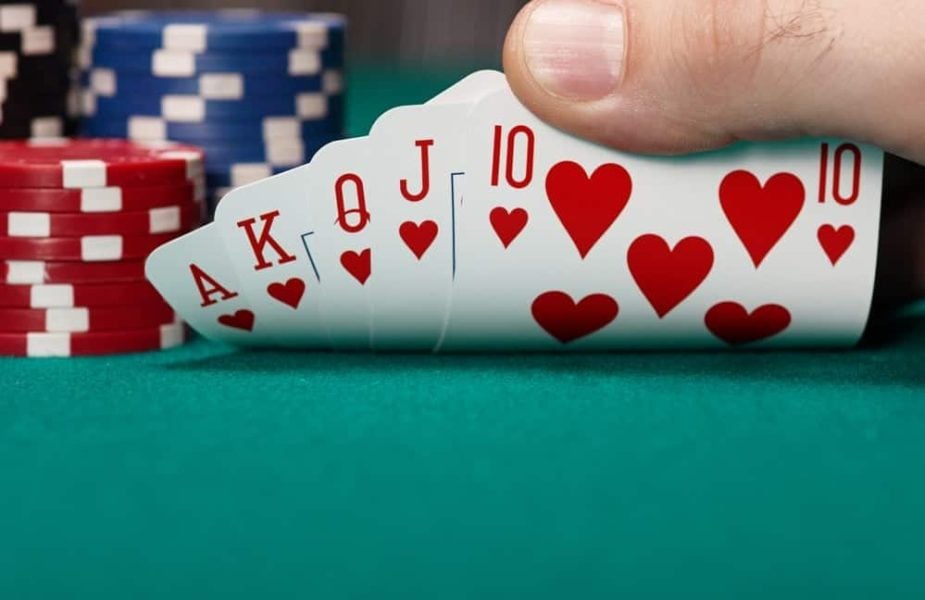
Poker hands rank from strongest to weakest as follows: royal flush, straight flush, four of a kind, full house, flush, straight, three of a kind, two pair, one pair and high card. Rarer hands beat more common ones, so a flush beats a straight and a full house beats both. When two players hold the same hand, the higher cards decide the winner.
Poker hand rankings are the single most important thing to learn in poker, because they are the same in nearly every variant you will play. Whether you sit down at Texas Hold’em, Omaha or a casino table game, the winning hand is decided by this one ranking, ordered by how rare each combination is. This guide lists all ten hands in order, shows what beats what, explains how ties break and gives the odds of each, building on our complete guide to poker.
- Ten hands, one order. From royal flush down to high card, ranked by how unlikely each is to be dealt.
- Rarer beats commoner. A flush beats a straight, and a full house beats a flush, because each is harder to make.
- Ties break by high card. Same hand type? The higher ranks win, then the kicker settles the rest.
- Suits never break ties. No suit outranks another in standard poker, so identical hands split the pot.
Poker hands in order, strongest to weakest
Here are all ten poker hands ranked from the best hand in poker down to the weakest. Each hand is made of exactly five cards, and the ranking is fixed: it does not change between Texas Hold’em, Omaha, stud or draw. Memorise this order and you can play almost any poker game.
| # | Hand | What it is | Example |
|---|---|---|---|
| 1 | Royal flush | A, K, Q, J, 10, all the same suit | A♥ K♥ Q♥ J♥ 10♥ |
| 2 | Straight flush | Five in sequence, all the same suit | 9♠ 8♠ 7♠ 6♠ 5♠ |
| 3 | Four of a kind | Four cards of the same rank | Q♣ Q♦ Q♥ Q♠ 3♥ |
| 4 | Full house | Three of a kind plus a pair | K♥ K♠ K♣ 8♦ 8♥ |
| 5 | Flush | Five of one suit, not in sequence | A♦ J♦ 8♦ 5♦ 2♦ |
| 6 | Straight | Five in sequence, mixed suits | 7♥ 6♠ 5♣ 4♦ 3♥ |
| 7 | Three of a kind | Three cards of the same rank | 9♣ 9♦ 9♥ K♠ 4♥ |
| 8 | Two pair | Two pairs of different ranks | J♥ J♠ 6♣ 6♦ A♥ |
| 9 | One pair | Two cards of the same rank | 10♥ 10♠ K♣ 7♦ 3♥ |
| 10 | High card | None of the above; highest card plays | A♠ Q♦ 9♥ 5♣ 2♠ |
Note that the old idea of hands like Texas Hold’em or Omaha being separate “hands” is a common beginner mix-up: those are game variants, not hands. Every one of them uses the same ten-hand ranking above. What changes between games is how you get your five cards, which our types of poker guide covers.
What beats what in poker?
The rule is simple: the rarer a hand is to be dealt, the higher it ranks. That single principle answers almost every “what beats what” question. Because a flush is harder to make than a straight, a flush beats a straight. Because a full house is harder still, it beats both. Here are the questions players ask most.
- Does a flush beat a straight? Yes. A flush (five of one suit) is rarer than a straight (five in sequence), so the flush wins.
- Does a straight beat three of a kind? Yes. A straight ranks sixth, three of a kind ranks seventh, so the straight is higher.
- Does a full house beat a flush? Yes. A full house ranks fourth and a flush fifth, so the full house wins.
- What is the best hand in poker? The royal flush, the A, K, Q, J, 10 all in one suit. It is the top straight flush and cannot be beaten.
- Does three of a kind beat two pair? Yes. Three of a kind is rarer than two pair, so it ranks higher.
If you ever forget, fall back on rarity. The hands you almost never see, four of a kind and better, sit at the top. The hands you see every few deals, a pair or high card, sit at the bottom. To see how those frequencies translate into the actual odds of hitting each hand, read our guide to poker odds and probabilities.
Poker hand comparator
Not sure which of two hands wins? Pick a hand type for each player below and the comparator will tell you which is stronger and why. It uses the exact ranking above, so it is a quick way to settle any “does X beat Y” question.
How ties are broken
When two players make the same type of hand, poker breaks the tie by comparing the cards that matter, from the highest down. This is where the kicker, an unpaired side card, often decides the pot. Suits are never used to break ties in standard poker, so if two hands are genuinely identical in rank, the players split the pot evenly.
- Same pair. A pair of aces beats a pair of kings. If both hold the same pair, the highest kicker wins, so A-A-K beats A-A-Q.
- Same flush. The flush with the highest top card wins; if those match, compare the next card down, and so on.
- Same straight. The straight with the higher top card wins, so a 6-to-10 straight beats a 2-to-6 straight.
- The wheel. The lowest straight is A-2-3-4-5, called the wheel, where the ace plays low. Here the five is the top card, so it loses to any higher straight.
One point the old rankings often get wrong: the ace is the only card that can play both high (above the king) and low (below the two). It cannot do both at once, so A-K-Q-J-10 is the top straight and A-2-3-4-5 is the bottom one, but Q-K-A-2-3 is not a straight at all.
The odds of each poker hand
The ranking order is not arbitrary; it mirrors exactly how rare each hand is among all possible five-card hands. There are 2,598,960 distinct five-card hands in a 52-card deck, and the rarer the combination, the higher it ranks. The table below shows how many of those hands make each rank, which is the reason a royal flush sits at the top and a pair sits near the bottom.
| Hand | Combinations | Probability |
|---|---|---|
| Royal flush | 4 | 0.000154% |
| Straight flush | 36 | 0.00139% |
| Four of a kind | 624 | 0.0240% |
| Full house | 3,744 | 0.144% |
| Flush | 5,108 | 0.197% |
| Straight | 10,200 | 0.392% |
| Three of a kind | 54,912 | 2.11% |
| Two pair | 123,552 | 4.75% |
| One pair | 1,098,240 | 42.3% |
| High card | 1,302,540 | 50.1% |
Poker hands cheat sheet
If you want a quick way to lock the order in, group the ten hands into three tiers. That makes the ranking far easier to recall at the table than a flat list of ten.
- The monsters (top three). Royal flush, straight flush, four of a kind. You will see these rarely, and they almost always win.
- The strong hands (middle four). Full house, flush, straight, three of a kind. These win plenty of pots and are worth betting hard.
- The everyday hands (bottom three). Two pair, one pair, high card. Common, often beaten, and the ones where reading the board and your opponents matters most.
The one tricky pair to remember is flush over straight and full house over flush. Everything else tends to sit where your intuition puts it. Once the order is second nature, your next step is learning what to do with each hand, which is the job of bluffing and betting strategy.
Practising poker hands in Canada
The fastest way to make the rankings automatic is to play. Low-stakes and play-money tables let you see hands go to showdown again and again, which cements the order far better than memorising a chart. Live dealer tables add the feel of a real game while keeping the same rankings you have just learned.