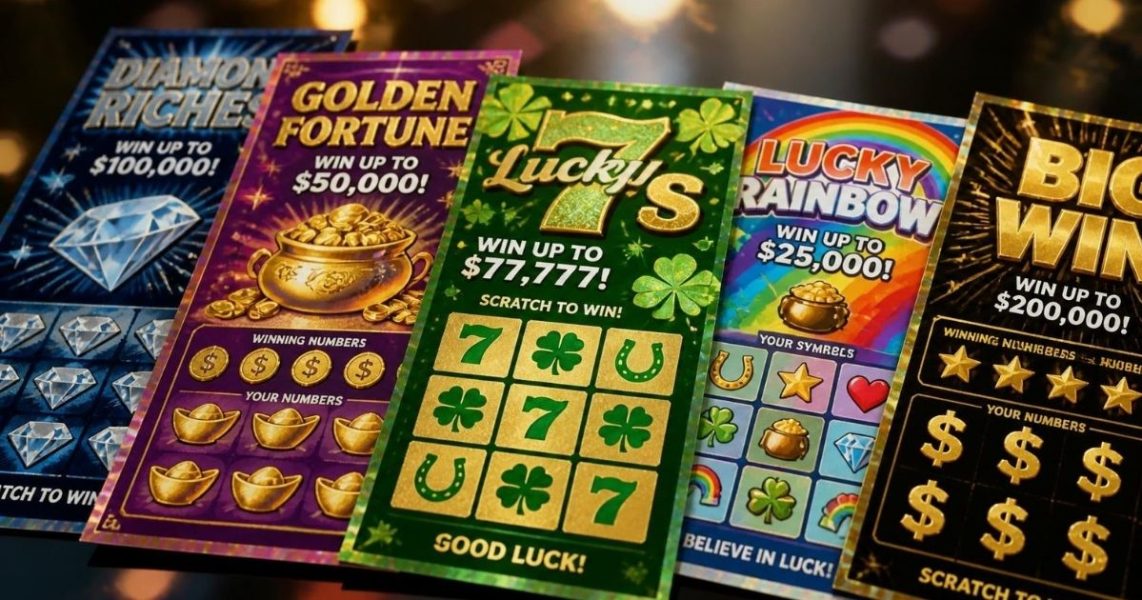
A scratch card is decided before you ever touch it. The whole print run is generated at once with a fixed number of winners scattered through it, then the tickets are boxed and shipped. Scratching does not determine anything. It only reveals what was already printed under the latex.
That one fact explains almost everything else about scratch cards. It is why the odds on the back never change, why top prizes can be gone long before a game is pulled from the counter, and why the one man who genuinely beat a scratch game did it by reading the front of the ticket rather than by scratching more of them.
- The odds on the back describe the print run, not the box in front of you. They are calculated once, before printing, and they never update as prizes are claimed.
- Top prizes can already be gone. Games stay on sale after the headline prize has been claimed, and nothing on the ticket tells you.
- The singleton method was real, and it is dead. It worked on one flawed Ontario game in 2003. That game was pulled and the flaw was designed out.
- Online instant wins work differently. There is no print run and no latex. The result is drawn at the moment you buy, so none of the physical tricks can apply.
How do scratch cards work?
A scratch card game is designed as a complete set before a single ticket is printed. The operator decides how many tickets the run will contain, how much each will cost, and exactly how many prizes at each level will be hidden inside it. A program then distributes those winners through the run and the tickets are printed, coated, cut and shipped in boxes to retailers.
By the time a ticket reaches a shop it is already a winner or a loser, and has been for weeks. Nothing you do at the counter changes it. Scratching is a reveal, not a draw. This is the single biggest difference between a scratch card and something like a slot machine, where the outcome genuinely is generated at the instant you press the button.
The consequence is that a scratch card game is a closed pool. Every prize in it is finite and countable. Buy the entire print run and you would win every prize exactly once, and you would still lose money, because the total value of the prizes is deliberately set below the total value of the tickets. That gap is the operator’s margin, and on scratch games it is typically much wider than on casino games.
| Decided before printing | Total tickets, ticket price, number of prizes at every level, where the winners sit in the run |
|---|---|
| Decided when you buy | Nothing at all |
| What scratching does | Reveals a result that was fixed at the printing stage |
| What the odds on the back mean | Total tickets divided by total winning tickets, across the whole run as printed |
What the odds printed on the back actually mean
If a ticket says the overall odds are 1 in 4.5, that means the print run contains one winning ticket for every 4.5 tickets made. It is a statement about the game as manufactured, and it is accurate on the day the run is printed.
What it is not is a statement about the tickets still on sale. Those odds are printed once and never revised. As a game sells through, prizes get claimed, and the pool left behind stops resembling the pool described on the back. The number on the ticket keeps saying 1 in 4.5 whether the top prize was claimed this morning or has not been claimed at all.
Most of that 1 in 4.5 is also the bottom tier, where the prize is your stake back or close to it. Winning something and winning anything meaningful are very different propositions, and the printed odds do not distinguish between them.
Some lottery operators publish how many prizes remain in each active game, which is the only reliable way to know what you are actually buying into. If that information is available for a game you play, it is worth more than anything printed on the ticket.
The singleton method: the one time someone genuinely beat a scratch game
The singleton method is real, it worked, and it was found in Ontario. It is also thoroughly dead, and understanding why is more useful than the trick itself.
In June 2003 Mohan Srivastava, a geological statistician in Toronto with degrees from MIT and Stanford, scratched a tic-tac-toe ticket a friend had given him as a joke and won three dollars. Walking to the shop to claim it, he started thinking about how the tickets were made. His day job was estimating how much gold sits in a deposit from a handful of samples, and the same reasoning applied here. The tickets were mass produced, which meant a program laid down the numbers. And that program could not be truly random, because the operator has to control exactly how many winners exist. It had to create the appearance of randomness while being carefully determined.
That was the crack. The game showed eight tic-tac-toe grids with 72 exposed numbers between 1 and 39, so some numbers necessarily repeated. Srivastava stopped reading them as digits and started counting how often each one appeared. Numbers that appeared exactly once on the whole ticket, which he called singletons, turned out to be almost always repeated under the latex. Three singletons in a line on the same grid meant the ticket was very probably a winner.
He could sort winners from losers without scratching anything, at around 90 percent accuracy on the Ontario game and roughly 70 percent on a Colorado version of the same design. It was simple enough that he taught it to his eight year old daughter.
What he did next is the part usually left out. He did not quietly work the flaw. He worked out that the margins were too thin to be worth a career, and phoned the Ontario Lottery and Gaming Corporation to report it. He was ignored, so he bought twenty tickets, sorted them unscratched into a pile of winners and a pile of losers, labelled both and posted them to OLG. They called him back within two hours. The game was pulled.
Why it does not work now
The flaw was specific to one printing design that let visible information correlate with hidden information. Once it was published in Wired in 2011 the entire industry knew, and ticket generation was reworked so the exposed numbers carry nothing about what sits under the coating. The vulnerability was a manufacturing bug, not a law of scratch cards, and bugs get fixed.
So if you find a page selling a singleton system today, what it is selling is a twenty year old story with the ending removed. The honest summary is that a very good statistician found a real flaw in one game, reported it rather than exploiting it, and the flaw was closed.
Do any of the other scratch card tactics work?
No, and the reason is always the same: the ticket was decided at the printing stage, so nothing you observe at the counter can change what is under the latex.
- Buying several tickets in a row from one roll. Winners are distributed through the run, not spaced at intervals. A roll is a slice of the run, not a pattern.
- Waiting until nobody has won recently. A game is not due. Prizes are already sitting in specific tickets and the game has no awareness of what has been claimed.
- Buying the more expensive tickets. Higher priced games usually do return a slightly larger share of stakes as prizes, so this one is not a myth exactly. It also means losing more per ticket when you lose, and the operator still keeps its margin.
- Weighing, tilting or feeling the ticket. Modern printing and coating are designed specifically to defeat this.
The one thing that genuinely changes your position is information the operator publishes: how many prizes at each level are still unclaimed in a live game. That is real data about the pool you are buying into, and it is the only edge available to an ordinary player. It is also not much of one.
Online scratch cards work in a completely different way
An online instant win game looks like a scratch card and behaves like one on screen, but underneath it is the opposite. There is no print run, no box of tickets and no fixed pool. The result is generated by a random number generator at the moment you buy, in the same way a slot spin is generated when you press the button.
That difference matters in both directions. Nothing can be depleted, so no online game can quietly run out of top prizes while still being sold. Equally, nothing can be counted, so there is no remaining prize list to consult and no physical flaw to spot. Every purchase is independent of every purchase before it, and the certified RNG behind it is tested by an independent laboratory rather than printed in a factory.
Practically, that means the singleton method and every other physical tactic are not merely ineffective online. They have nothing to attach to. In Ontario, instant win games offered by registered operators also sit under the same AGCO game design rules as slots, including the requirement that the return to player figure is reachable in a single click.


Whichever you use, check it holds a licence that covers you where you live. Our guide to safe online casinos in Canada covers what to look for before depositing.
Playing responsibly
Scratch cards are cheap, immediate and designed to be bought repeatedly, which is exactly the combination that makes them easy to spend more on than you intended. The low ticket price is the point: it makes each purchase feel inconsequential while the total quietly accumulates.
Decide what a session costs before you start and treat it as the price of the entertainment rather than a stake you expect back. If it stops feeling like a treat, our responsible gambling guide has a self assessment, and the Problem Gambling Helpline is free and confidential on 1-888-230-3505.