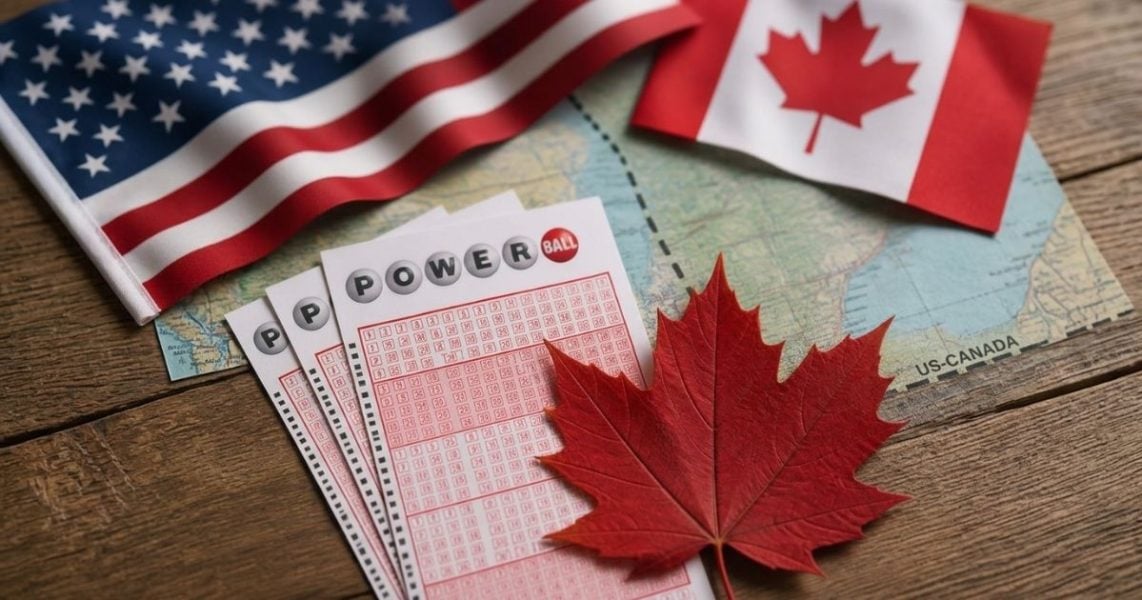
Canadians can play U.S. Powerball. There is no citizenship or residency requirement to buy a ticket or claim a prize, including the jackpot. What Canadians cannot do is buy directly from a state lottery site, so the two realistic routes are a courier service that buys a ticket on your behalf, or crossing the border and buying in person.
Powerball is not sold in Canada, and it never has been. Lottery schemes here are reserved to the provinces, so the jackpot you keep seeing in the news is one you cannot buy a ticket for at any Canadian counter. That does not make it off limits. It means the route in matters, and the route you choose decides who actually owes you money if your numbers come up.
- Eligibility is not the problem, purchase is. Powerball is sold in 45 U.S. states, Washington D.C., Puerto Rico, the U.S. Virgin Islands and, since 21 July 2026, the United Kingdom. Canada is not on that list.
- The jackpot odds are 1 in 292,201,338. The odds of winning anything at all are about 1 in 24.87, and most of those wins are the bottom 4 dollar tier.
- Couriers and lottery betting sites are different products. One buys you a real ticket in the official draw. The other sells you a bet on its outcome.
- A U.S. win does not arrive whole. Canada does not tax lottery winnings, but the United States withholds on prizes paid to non residents.
Can Canadians play Powerball?

Yes. Powerball does not require winners to be U.S. citizens or residents, and every prize tier including the jackpot can be claimed by a Canadian. The obstacle is not eligibility. It is purchase.
Official state lottery platforms require the buyer to be physically inside that state at the moment of purchase, and tickets cannot be sold across state lines or across the national border. No Canadian retailer sells Powerball, because lottery schemes in Canada are reserved to the provinces under section 207 of the Criminal Code, which is why every domestic draw you can buy at a corner store runs through OLG, Loto-Quebec, BCLC, ALC or WCLC.
So a Canadian who wants in has two options, and they carry different trade offs.
How Powerball actually works
The mechanics are simple and they have not changed, despite claims circulating online about a price rise and a larger number pool. Both are false.
| Ticket price | 2 dollars USD per play. Power Play adds 1 dollar, Double Play adds another. |
|---|---|
| Numbers | Five from 1 to 69, plus one red Powerball from 1 to 26. |
| Draws | Monday, Wednesday and Saturday at 10:59 p.m. Eastern. |
| Starting jackpot | 20 million dollars, rolling over until someone matches all six. |
| Prize tiers | Nine, from 4 dollars for the Powerball alone up to the jackpot. |
Power Play multiplies non jackpot prizes by 2, 3, 4, 5 or 10 times, with the 10x multiplier only available when the advertised jackpot annuity is 150 million dollars or less. Match all five white balls with Power Play added and the prize is a fixed 2 million dollars regardless of which multiplier is drawn.
What the odds really are
The odds of winning the Powerball jackpot are 1 in 292,201,338, and that figure is not an approximation. It is the exact count of possible combinations of five numbers drawn from 69 plus one from 26. A second ticket gives you two of those combinations instead of one.
No selection method changes this. Hot numbers, cold numbers, birthdays, patterns on the slip and systems sold online all leave the jackpot probability exactly where it was, because each draw is independent and the machine has no memory of the last one. The one thing your choice genuinely affects is who you share with. Picking dates confines you to 1 through 31 and clusters you with everyone else doing the same, so a winning combination made of dates is more likely to be split.
Two ways to play from Canada
A lottery courier service
A courier, also called a messenger or concierge service, does not sell you a lottery ticket. It takes your instruction, buys a real physical ticket on your behalf through an agent inside a U.S. selling state, and uploads a scan of that ticket to your account before the draw. You are the ticket holder. The courier is the errand runner.
- Register and complete identity verification with your name, date of birth, address and phone number.
- Set deposit limits at sign up, before you play rather than after.
- Add a payment method that works from Canada and deposit funds.
- Choose five numbers from 1 to 69 and your Powerball from 1 to 26, or take a quick pick.
- Check the ticket scan appears in your account before the draw closes. It should show the draw date, your numbers and the issuing state.
Buying in person across the border
If you live near the border you can walk into an authorised retailer in a Powerball state and buy exactly like a local. No residency test, no verification, no service fee. During large jackpots, Canadian buyers can make up a serious share of sales at border town stores.
There is one wrinkle almost nobody mentions. A long standing U.S. federal statute prohibits importing lottery tickets into the United States from a foreign country. Carry your ticket home to Canada, then drive back to claim it, and on a strict reading you are importing a lottery ticket. It is rarely the practical problem people fear, but it is a real reason some players leave the ticket in the U.S. or prefer the courier route, where the physical ticket never crosses the border at all.
Age follows the issuing state, not your province. Most Powerball states set the minimum at 18, but Arizona and Iowa require 21. Bring photo identification, and a passport for any significant prize.
Couriers and lottery betting are not the same product
This is the distinction that matters most when you compare lottery sites, and it is the one most comparison pages skip. Two operators can advertise the same Powerball jackpot while selling you fundamentally different things.
A courier, which is what theLotter, Jackpot.com and Lotto Agent are, buys a real ticket from an authorised retailer on your behalf and charges a service fee on top of the face value. That ticket exists, it is yours, and you are entered in the official draw. If it wins, the operator collects from the lottery and passes the money to you. The operator never runs a draw and never carries the prize liability, because the prize is always the official lottery’s to pay.
A lottery betting site, which is the Lottoland model, sells you a bet on what the draw will produce. No ticket is bought, and you are not in the official draw at all. The operator undertakes to match the official prize at whatever tier you hit, funding small wins from its own revenue and covering large ones through an insurance policy taken out for exactly that purpose. Firms operating this way hold betting licences rather than lottery licences.
| Courier | Lottery betting | |
|---|---|---|
| Is a real ticket bought? | Yes, and it is yours | No ticket exists |
| Are you in the official draw? | Yes | No, you bet on its outcome |
| Who pays if you win big? | The lottery, via the courier | The operator, backed by an insurer |
| What you pay | Ticket price plus a service fee | A bet stake, often cheaper |
| Licence held | Service or courier permission | A betting licence |
Neither model is a scam and both have paid out real jackpots. But the difference decides who owes you money if you win, and that is worth understanding before you deposit rather than afterwards. With a courier your claim ultimately rests on an official lottery. With lottery betting it rests on a private company and its reinsurance, which is a different kind of promise even when the operator is licensed and solvent.
Regulators have taken a view too. Australia outlawed betting on lottery outcomes in January 2019, after which Lottoland shifted its Australian product to betting on financial market indices instead. That is not an accusation against any operator, but it does show the model carries a regulatory exposure the courier model does not.
Why the UK can now buy directly and Canada still cannot
On 21 July 2026 Powerball began selling tickets in the United Kingdom through the UK National Lottery. It is the first expansion since Mississippi joined in 2020, and the first ever outside U.S. jurisdictions.
Nothing about the game changed. The ticket price stayed at 2 dollars, the draw nights stayed the same, and the odds stayed identical. The stated reason is that a larger player base makes jackpots grow faster for everyone. Powerball has said there are no specific plans to expand beyond the United Kingdom at this stage.
For Canadians that means the direct route remains closed, and the courier and border options are still the only ways in.
If a Canadian wins
Smaller prizes bought through a courier are credited to your account balance and withdrawn through your usual payment method. Large prizes and jackpots generally require an in person claim at the state lottery that issued the ticket, and established couriers assist with travel and paperwork.
Tax is where Canadian winners get caught out. Canada does not treat lottery winnings as taxable income, so a Lotto Max win arrives whole. A U.S. win does not. Prizes paid to non resident aliens are subject to U.S. federal withholding at a higher rate than the rate applied to U.S. residents, and individual states may withhold on top. Any claim that you keep one hundred percent of a U.S. jackpot is simply wrong.
Playing responsibly
Powerball is a game of pure chance with an enormous house edge relative to almost anything else you could bet on. It is entertainment, and the ticket price is what the entertainment costs. It is not an investment and it is not a plan.
Set deposit limits when you register rather than when you feel you need them, and read our responsible gambling guide if play stops feeling like a treat. The Problem Gambling Helpline is free and confidential on 1-888-230-3505.