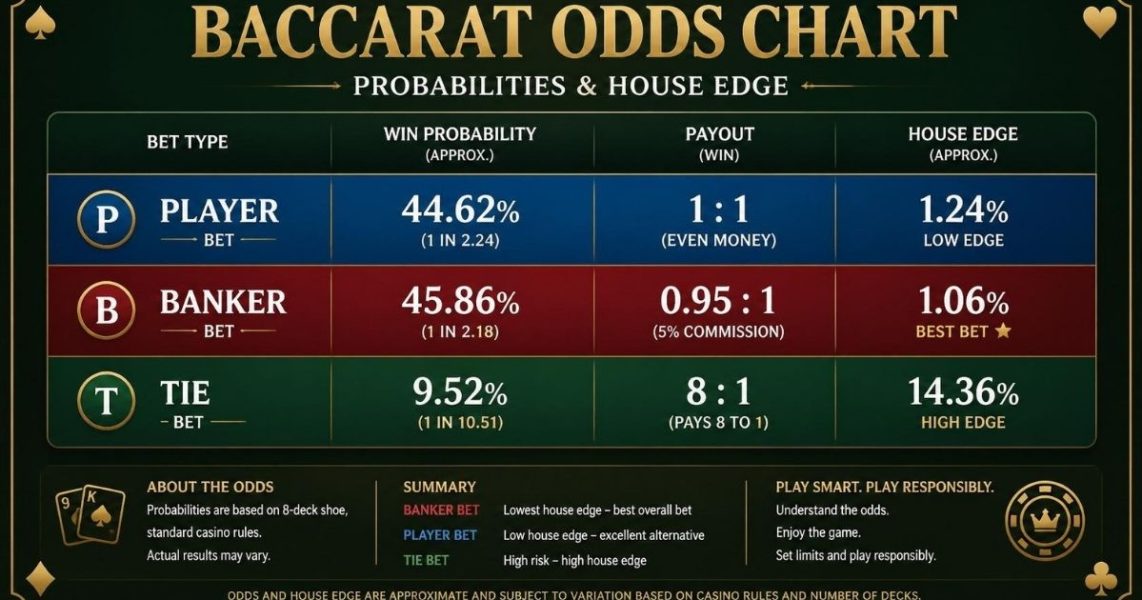
In baccarat the Banker wins about 45.9 percent of hands, the Player 44.6 percent, and 9.5 percent tie. The house edge is 1.06 percent on Banker, 1.24 percent on Player and 14.36 percent on the Tie. The Banker is the best bet, its slim edge the reason for the five percent commission on Banker wins.
Baccarat has some of the lowest house edges in the casino and one of the highest, all at the same table. The difference between a smart bet and a poor one comes down to a couple of percentage points that are easy to overlook. This guide lays out the win probabilities, the house edge and payout of every main bet, why the Banker carries a commission, and how no-commission tables quietly cost you more. A calculator at the end turns those percentages into the real dollars each bet is expected to cost. New to the game? Start with our how to play baccarat guide first.
- The win chances are close. Banker takes about 45.9 percent of hands, Player 44.6 percent, and 9.5 percent tie.
- House edge ranks clearly. Banker 1.06 percent, Player 1.24 percent, Tie 14.36 percent, so Banker is best and Tie is worst.
- The commission has a reason. Banker wins just over half of decided hands, and the five percent charge claws that advantage back.
- No-commission is not a deal. Super 6 rules push the Banker edge up to about 1.46 percent, worse than the standard game.
What are the odds in baccarat?
On a standard eight-deck game the Banker hand wins about 45.9 percent of the time, the Player hand about 44.6 percent, and roughly 9.5 percent of hands end in a tie. Those figures come from the fixed drawing rules, not from luck on the night, and they are the same every hand regardless of what came before.
The Banker’s edge looks tiny, and it is, but it is real. Strip out the ties, which simply push on Player and Banker bets, and the Banker wins about 50.7 percent of the decided hands to the Player’s 49.3 percent. That sliver is why the Banker is the better side, and why the casino charges a commission to stop it becoming a winning bet for you. It is also why chasing streaks does not work: as we explain in our baccarat strategy guide, each hand is independent.
Baccarat house edge by bet
House edge is the share of each bet the casino expects to keep over time. In baccarat it ranges from among the best odds on the floor to among the worst, depending entirely on which bet you make.
| Bet | House edge (8 decks) | Verdict |
|---|---|---|
| Banker | 1.06% | Best bet |
| Player | 1.24% | Fine second choice |
| Tie (pays 8:1) | 14.36% | Avoid |
The gap is stark. For every 100 dollars wagered, the Banker bet costs you about a dollar over the long run, the Player a little more, and the Tie more than fourteen dollars. The Tie’s eight to one payout looks tempting, but it lands under ten percent of the time, nowhere near often enough to justify the price. Side bets sit even further out on the same curve, as our baccarat side bets guide shows.
Baccarat payouts
The payouts are simple, with one wrinkle on the Banker bet. Here is what each main bet returns on a winning wager:
| Bet | Payout | Note |
|---|---|---|
| Player | 1 to 1 | Even money |
| Banker | 1 to 1 minus 5% | Effectively 0.95 to 1 after commission |
| Tie | 8 to 1 | 9 to 1 at some tables, which lowers the edge |
A winning 100 dollar Banker bet returns 95 dollars in profit rather than 100, the five dollar difference being the commission. It is worth checking the Tie payout at your table too: a table paying nine to one on the Tie cuts its house edge from about 14.36 percent to roughly 4.85 percent, still poor, but far less brutal.
The 5% commission and no-commission baccarat
The five percent commission on Banker wins is the engine of the whole game. Because the Banker acts after the Player and can react to the Player’s third card, it wins slightly more than half of all decided hands. Left unchecked, always betting Banker would hand the player an advantage, so the casino takes five percent of each Banker win to tip the balance back. That single charge is what turns a Banker-favouring game into a house-favouring one.
Some tables advertise no-commission or Super 6 baccarat, paying even money on Banker wins with no deduction. It sounds better, but there is a catch: a Banker win with a total of six pays only half. That one rule is enough to raise the Banker house edge from 1.06 percent to about 1.46 percent. So despite the appealing name, no-commission baccarat is the more expensive game. The same no-commission idea appears in some variants, which we cover in our baccarat variants guide.
Baccarat house edge calculator
Pick a bet, set your stake and how many hands you plan to play, and the calculator shows that bet’s house edge, its win, tie and loss chances, and the total it is expected to cost you over the session. Switch the Banker between standard and no-commission to see the Super 6 penalty in action.
The best bet in baccarat
Put the numbers together and the conclusion is plain: bet the Banker. At 1.06 percent it is the cheapest bet on the table, the Player bet at 1.24 percent is a reasonable alternative, and everything else, the Tie and the side bets, costs far more. There is no pattern, system or streak that changes these fixed edges, so the only meaningful decision in baccarat is which bet to back.
That also makes baccarat one of the most beginner-friendly games in the casino. Unlike blackjack, where the house edge depends on playing every hand correctly, baccarat asks nothing of you beyond choosing the Banker and managing your bankroll. Get those two things right and you are playing the game about as well as it can be played.
Playing baccarat for real money in Canada
Once you know which bets carry the best odds, the rest is finding a trustworthy table. Canadian players can play baccarat in Canadian dollars at licensed online casinos, in both software and live dealer formats, and start at stakes low enough to keep those small edges from adding up quickly. Stick to the Banker, mind your bankroll, and treat the game as entertainment with a known cost.