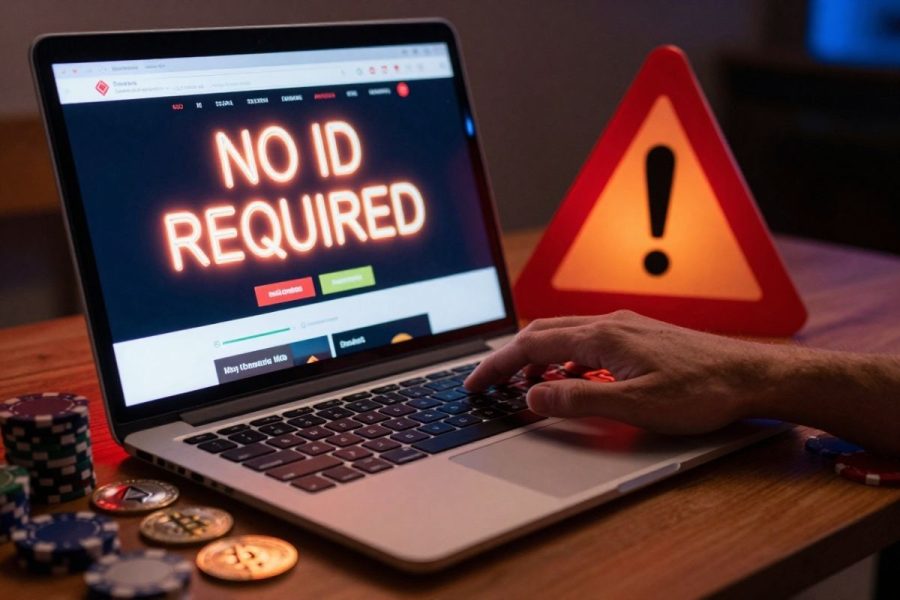
A casino that asks you for no identity documents at all is a red flag, not a privacy perk. KYC underpins the three things that keep a casino alive: licensing, banking and games. Some reputable sites let you start without it, but a serious operator always verifies you eventually, usually before a payout. We could not find a single no-KYC casino, licensed by a reputable jurisdiction, that we would stand behind.
“No KYC casino” is one of the most searched phrases in crypto gambling right now, and it gets marketed as a top perk: no ID, no proof of address, no selfie, just deposit and play. We see it differently. After years of reviewing operators, our view is straightforward: a casino that asks you for nothing is not protecting your privacy, it is showing you a red flag. This article explains why, what we found when we went looking for a no-KYC option, and what to weigh before you hand money to a site that wants no documents in return.
- A casino that asks for nothing is a red flag, not a privacy perk.
- KYC underpins the three things that keep a casino alive: licensing, banking and games.
- Some casinos let you start without KYC, but a serious operator always asks eventually, usually before a withdrawal.
- We could not find a reputably licensed no-KYC casino, a missing licence and unknown ownership usually travel together.
What KYC actually is
KYC stands for Know Your Customer. It is the set of identity checks a casino runs to confirm who you are, usually your ID, proof of address and sometimes a selfie. It is not bureaucracy for its own sake. KYC is how a casino verifies you are of legal age, enforces self-exclusion if you ever need it, meets anti-money-laundering and other requirements imposed by the licensing authority, and confirms that the person withdrawing the winnings is the person who deposited. If you want the plain-English version of this and other terms, our glossary of gambling terms covers it.
The three things that keep a casino alive, and why each one needs KYC
Most players never see the machinery behind an online casino. Three things keep one alive: licensing, games, and banking. Every one of them runs on identity checks. Remove KYC and you are not looking at a freedom play. You are looking at an operator that may not have those three things properly in place, or has them only loosely in place at best.
Licensing
Every reputable licensing jurisdiction requires operators to verify their players. It is a condition of holding the licence, not an optional extra. The stricter regulators, the Malta Gaming Authority, Gibraltar and the Kahnawake Gaming Commission, build identity and anti-money-laundering checks into their standards. Curaçao, long seen as the looser offshore option, has tightened sharply under its 2024 reform: licences are now issued directly by the Curaçao Gaming Authority, with beneficial-owner checks, mandatory anti-money-laundering rules and a public register, and anonymous crypto operators are turned away. Where no-KYC sites tend to cluster is the genuinely weak end, places like Costa Rica and Belize that run no real gambling regulator at all, or cheap newcomer licences with little oversight. When a casino advertises that it asks for nothing, the obvious question is what licence it actually holds, and whether that licence is worth anything.
Banking
This is the one outsiders underestimate. To take and pay out money, a casino, or any business, needs merchant accounts, card processing, e-wallet rails, and increasingly crypto payment processors. Those providers do not onboard an operator and then look away. They require KYC, fraud monitoring and ongoing compliance as a condition of keeping the relationship. Many of these processors are large, heavily regulated financial companies, bound by strict anti-money-laundering laws in the US, UK and EU. Visa processing, wallet payments, even the rails used to move crypto, all sit behind that expectation. A casino that collects no documents is a casino that may not have, or may not be able to keep, that banking in place. And banking is what pays you.
Games
The studios worth playing, the providers whose names you recognise, choose who they plug into. They want to be paid, and they want partners who stay compliant so the relationship survives an audit. Skip KYC and you often skip the quality providers along with it.
So when a casino asks you for ID, proof of residence, even a selfie, reframe how you read it. That is not friction being thrown in your way. It is a signal that the operator intends to stay compliant, intends to keep the banking and provider relationships that let it pay you, and intends to be around long enough to do it.
Some casinos let you start without KYC, but never skip it entirely
Here is the nuance worth getting right. Some reputable casinos will let you sign up and play up to a certain amount or period, often a smaller deposit, before they ask for any documents. That is a normal way to reduce friction for new players and manage risk on small sums. What it is not is permanent. At some point the casino will come along and request your KYC, and a serious operator always does, whether that is as your deposits add up, when you go to withdraw, or as part of routine compliance on the account after a certain period.
That is what should reframe your search. The question is not which casino will let you stay anonymous forever, because a trustworthy one will not. It is whether the operator behind the site is licensed, accountable, and built to still be there when it is time to pay you.
What we found when we went looking
We did not reach this position from theory. We went looking for a no-KYC casino we could actually stand behind, and we could not find one. We could not find a single casino, licensed out of a reputable jurisdiction, that allows you to deposit and withdraw with no identity verification at all.
What we found instead was telling. Most no-KYC sites do not display their casino licensing in the footer. Often it is not even in the terms and conditions either. Ownership is simply unknown or difficult to source: no named operating company, no registration number, no jurisdiction you could escalate a dispute to if a payout went wrong. When the licence, the owner and the recourse are all missing or hidden, “no KYC” stops looking like a privacy feature and starts looking like the natural result of an operation that was never built to be accountable in the first place. We break down how to spot these sites, and what to do if one refuses to pay, in our guide to online casino scams.
A reputable casino vs a no-KYC site
The same six signals separate an accountable operator from one you cannot trace. This is what to look for, side by side.
| Signal | Reputable, licensed casino | No-KYC, unlicensed site |
|---|---|---|
| Licence | Shown in the footer with a verifiable number | Often missing, or not in the terms |
| Ownership | Named operating company and registration | Frequently unknown or hidden |
| Identity checks | At signup or before a payout | None at all, the red flag |
| Payment providers | Recognised card, wallet and crypto rails | Obscure or unnamed |
| If a payout stalls | Escalate to the regulator or an ADR scheme | No regulator to turn to |
| Self-exclusion | Tools available and enforced | Not enforced |
Our honest take
We want to be fair about this. If you want to take that risk and play at a no-KYC casino anyway, that is your call to make. We have nothing against these operations, and there are players who value anonymity for genuine privacy reasons. The privacy trade-off is real: KYC does mean handing over documents, and that is a fair thing to weigh against the safety it brings.
But we are all about trust, safety and reputation, and that is exactly what needs to be considered when you go searching for one of these sites. The most common complaint at anonymous casinos is not a privacy breach. It is a withdrawal that suddenly demands verification at the worst possible moment, or a payout that simply never arrives.
What to check before you play anywhere
Whether a site asks for KYC or not, run the same quick checklist before you deposit. For a fuller walkthrough, see our guide to playing at safe online casinos in Canada.
- Licence in the footer. A real operator displays its licence and a verifiable number, not just a logo, or at the very least lists it in the terms and conditions.
- A reputable jurisdiction. Malta, Gibraltar, Kahnawake and a reformed Curaçao have standards and a complaints process. A licence from a place with no real regulator, such as Costa Rica or Belize, or no named jurisdiction at all, is a warning.
- Identifiable ownership. You should be able to find the operating company and registration in the terms. Unknown ownership means no accountability.
- Recognised payment providers. Established card, wallet and crypto rails are a sign the operator passed someone else’s compliance checks.
- Known game studios. The big names only partner with operators who pay and stay compliant.
- Clear KYC and withdrawal terms. Vague or missing terms around verification and cashouts are a red flag in themselves.
Why our lists only include KYC casinos
This is why every casino in our guides runs decent identity checks, and why we count that in their favour rather than against them. We build our lists the way we always have, on reputation, history and a sound licensing approach, and then we layer in the part players actually came for. In crypto, that is the speed and convenience of paying and getting paid in coins like Bitcoin, Ethereum and stablecoins. You can see how that plays out in practice in our guide to the best Bitcoin and crypto casinos in Canada, which contains no no-KYC sites by design.
Crypto belongs at the cashier. Anonymity, at a casino you expect to pay you, does not.