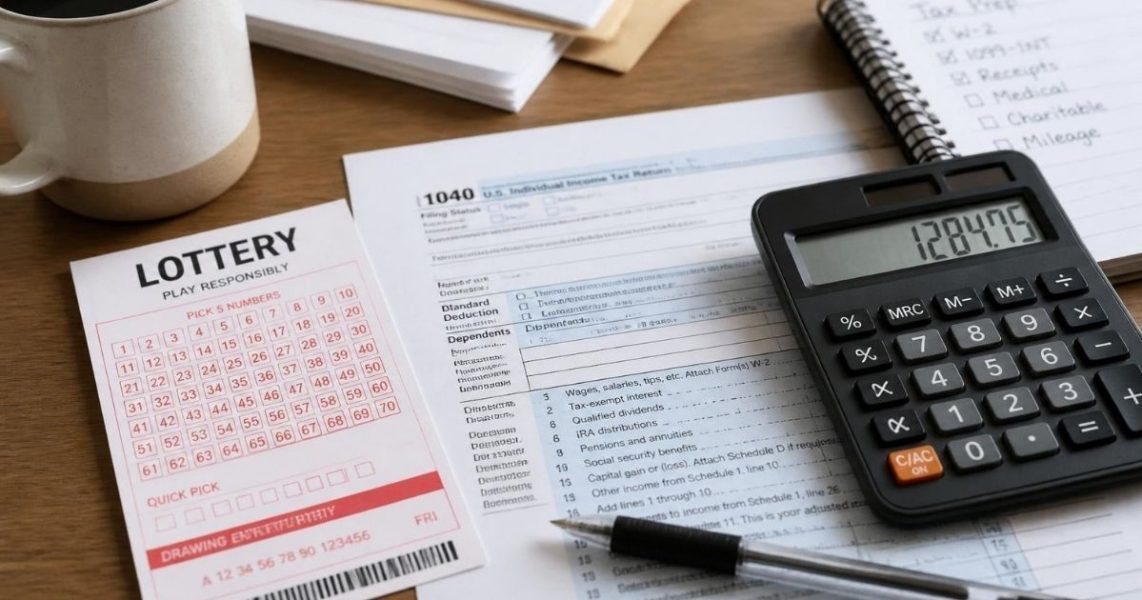
No. Are lottery winnings taxed in Canada? Not for a recreational player. A lottery prize or a casino win is treated as a windfall, and the Income Tax Act deems the gain on it to be nil, so you keep the full amount and report nothing. Tax enters the picture in only two situations, and both are narrower than people expect.
- Recreational winnings are not taxed. Lottery, casino, sports betting and poker wins are all treated the same way for a casual player.
- The interest your winnings earn is taxable. The prize is tax free; the income it produces once it sits in an account is not. This is the one that catches people.
- Gambling as a business is taxable, but the bar is high and the CRA weighs specific factors rather than how much you won.
- Losses are not deductible for a recreational player, which is the flip side of winnings not being taxed.
Canada is unusual here. In the United States gambling winnings are ordinary taxable income and large payouts are withheld at source. In Canada a person who buys a ticket and wins keeps every dollar, with no form to file and no threshold to cross. That is the rule almost everyone needs. There are two exceptions, and both are worth knowing: one catches winners quietly, and the other is widely misunderstood.
Are lottery winnings taxed in Canada?
No. A lottery prize won by a recreational player is not taxable in Canada, as either income or a capital gain.
This is not an administrative concession or a threshold that large wins eventually cross. It is written into the Income Tax Act. Paragraph 40(2)(f) states that a taxpayer’s gain or loss from the disposition of a chance to win a prize or bet, or a right to receive winnings on a bet, in connection with a lottery scheme or a pool system of betting, is nil.
Deeming the gain to be nil is what makes the prize vanish from your tax return entirely. There is no reporting requirement, no threshold, and no difference between a C$20 scratch card and a multi-million dollar jackpot. The same treatment applies whether you bought the ticket at a counter or played through a provincial site, and it covers scratch cards on exactly the same basis.
Why a win counts as a windfall
Canadian tax law taxes income from a source, and a lucky win is not considered to come from one.
Income tax attaches to employment, business, property and capital gains. A prize arrived at by chance sits outside all four. It is a windfall: money that reached you without a productive source behind it, in the way an inheritance or a gift does. That is why the treatment is the same across every game, from the lottery through to the casino and the sportsbook. Our guide to the types of gambling that exist in Canada sets out how each form is governed.
| What you won | How it is treated |
|---|---|
| Lottery prize | Not taxable. A windfall, and the Act deems the gain on it to be nil. |
| Scratch card prize | Not taxable. Treated identically to any other lottery scheme prize. |
| Casino win | Not taxable. The same treatment applies online and in person. |
| Sports bet | Not taxable, whatever the stake or the size of the return. |
| Poker winnings | Not taxable for a recreational player, even though skill is involved. |
| Interest earned afterwards | Taxable. Once the money is yours, what it earns is ordinary investment income. |
That holds for a wager placed through one of the licensed sports betting apps in Ontario just as it does for a lottery ticket. Lottery prizes get a further layer of protection: even where a person is found to be carrying on gambling as a business, a prize from a genuine lottery scheme is still not taxed, because the outcome turns entirely on chance and no amount of skill changes it.
When gambling winnings do become taxable
Winnings become taxable only when a person is carrying on gambling as a business, and the amount won is not what decides it.
This is the most misunderstood part of Canadian gambling tax. People assume a big enough win, or a good enough year, converts them into a professional. It does not. What matters is the character of the activity, and the Canada Revenue Agency weighs three things:
- Special knowledge or inside information that lets the person reduce the element of chance, rather than simply playing well.
- The intention behind the gambling. Playing for pleasure sits on one side; gambling for profit as a means of gaining a livelihood sits on the other.
- The extent of the activity, including the number and frequency of bets.
The leading authority is a 2006 Tax Court decision, Leblanc v. The Queen, in which two brothers who had wagered enormous sums on sports lotteries over several years were found not to be carrying on a business. Their winnings stayed tax free. If that scale of activity did not cross the line, an ordinary player having a good run is nowhere near it.
Where someone genuinely is in business, the treatment flips entirely: winnings become business income, and expenses and losses become deductible against them. It is a different tax world, not a penalty applied to the same one.
The interest on your winnings is taxable
The prize itself is tax free, but any interest or investment income it earns after you receive it is fully taxable in the ordinary way.
This is the trap, and it is the opposite of the one people brace for. Win a large prize, put it in a savings account or an investment, and the money it produces from that point is interest, dividends or capital gains like any other. Your financial institution will issue a slip. The Canada Revenue Agency will expect it on your return.
The distinction is between the windfall and what the windfall goes on to do. The first is outside the tax system. The second is squarely inside it. For anyone who has just won a meaningful sum this is the conversation worth having with an accountant, and it is the only part of a Canadian win that needs planning at all.
Can you deduct gambling losses in Canada?
No. A recreational player cannot deduct gambling losses, for the same reason winnings are not taxed.
The two rules are a matched pair. Paragraph 40(2)(f) deems the gain or loss on a bet to be nil, and that second word does as much work as the first. If a losing bet produced a deductible loss, every player in the country would be filing one. Because the activity sits outside the tax system, nothing moves in either direction.
This is where Canada and the United States genuinely diverge. American players report winnings as income and may deduct losses against them, subject to conditions. Canadians do neither. Both systems are internally consistent: tax the wins and allow the losses, or ignore both.
Is your win taxable?
Most situations resolve quickly once you separate the win itself from what happens to the money afterwards.
How Canada compares internationally
Canada sits with the United Kingdom, Ireland, Australia and New Zealand in a group of countries that tax the operator rather than the player.
The United Kingdom reaches the same outcome by a different route. British players pay nothing on winnings, and the burden sits entirely on operators through gambling duties, which apply to offshore companies serving British customers as well as domestic ones. A player in either country keeps the full amount.
The United States is the outlier a Canadian is most likely to meet. Gambling winnings there are ordinary taxable income, and a casino will normally withhold tax at source from a non-resident’s substantial win before paying it out. That withholding is an American rule applied in America. Canada does not do the equivalent to visitors, and a Canadian who wins at home has nothing withheld.
Cross-border winnings are the only case where a second country’s rules come into it, and that is a question for a cross-border tax professional rather than a guide.
What to do if you have just won
For almost every Canadian winner the answer is that there is nothing to do at tax time at all.
You do not report the prize. You do not need a receipt, a form or a ruling. If the amount is small, that genuinely is the end of it. Where the amount is large enough to change your circumstances, the tax question moves from the win to the money, and three things are worth attending to:
- Any account the money sits in will generate taxable income, and you will receive a slip for it.
- Sheltering some of it inside a registered account changes how that income is taxed, which is a planning question rather than a gambling one.
- If gambling has been a source of livelihood rather than entertainment, raise the business question with an accountant before the CRA raises it with you.
Keeping it in proportion
A tax-free win is a good thing, but it is worth remembering what produces one. Lottery and casino play is designed to be quick and repeatable, and the absence of tax does not change the underlying odds or the cost of playing across a run of draws.
If it stops feeling like entertainment, our responsible gambling guide has a confidential self assessment, practical limit-setting tools and free support lines for every province and territory.