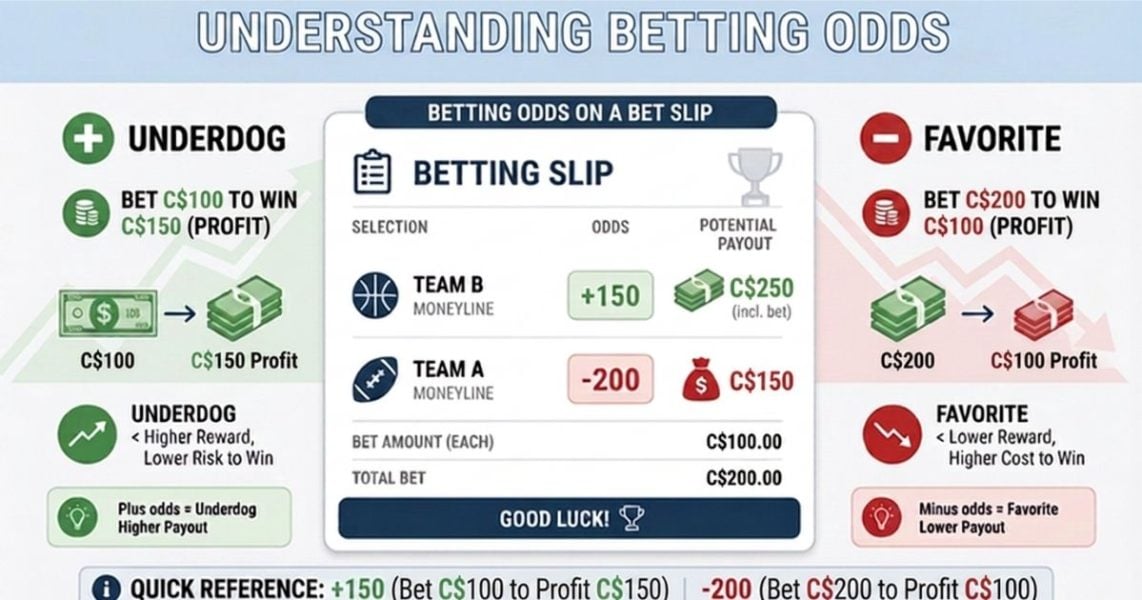
In betting odds, the minus sign marks the favourite and tells you how much you must risk to win C$100. The plus sign marks the underdog and tells you how much C$100 would win. So -150 means risking C$150 to win C$100, while +150 means C$100 wins C$150.
That is the whole rule, and everything else on this page is detail built on top of it. The signs are not ratings, predictions or confidence scores. They are prices, and once you can read a price you can compare one sportsbook against another instead of guessing.
- Minus is the favourite, plus is the underdog. Both are measured against C$100, which is why C$100 keeps appearing even when you are betting C$20.
- The bigger the number, the more lopsided the price. A price of -400 is a heavier favourite than -120. A price of +600 is a longer shot than +130.
- Every price converts to a percentage. That percentage is what the book implies about the chance of winning, and it always includes the operator’s margin.
- On a points spread, the signs mean something different. There they describe the handicap applied to the team, not the payout. Two plus and minus systems sit side by side.
In betting, what does + mean?
A plus sign means the selection is the underdog, and the number that follows is the profit a C$100 stake would make. At +250, a winning C$100 bet returns C$250 in profit plus your C$100 back, so C$350 lands in your account. At +120 the same C$100 wins C$120 profit, for C$220 returned.
The stake does not have to be C$100. That figure is just the reference point the format is built around, and everything scales proportionally. A C$25 bet at +250 wins C$62.50, because C$25 is a quarter of C$100 and C$62.50 is a quarter of C$250.
A longer plus number means the book considers the outcome less likely. At +600 you are being offered six times your stake in profit, which sounds generous until you notice the book is implying it happens roughly one time in seven.
And what the minus sign tells you
A minus sign means the selection is the favourite, and the number that follows is what you must risk to win C$100. At -150 you stake C$150 to win C$100, returning C$250 in total. At -110, the most common price in sports betting, you stake C$110 to win C$100.
Larger minus numbers mean heavier favourites and thinner payouts. At -400 you are risking C$400 to win C$100, which is a return of 25 percent on a bet the book expects to win four times out of five. Backing heavy favourites feels safe because they usually win, but the payout is priced accordingly and a single loss erases several wins.
This is where the two signs meet. A price of -100 and a price of +100 are the same thing: an even bet, where C$100 wins C$100. Books usually write it as +100 or as “even”.
The same price written three different ways
American odds with their plus and minus signs are only one of three formats, and Canadian sportsbooks normally let you switch between them in the settings. Decimal odds are the most common default in Canada and Europe, fractional odds are traditional in British horse racing, and all three describe exactly the same price.
Decimal odds show your total return per C$1 staked, including the stake itself. Decimal 2.50 means C$1 returns C$2.50, so C$1.50 of that is profit. Fractional odds show profit against stake, so 3/2 means three units of profit for every two staked. Neither uses a plus or minus sign, which is why switching format is often the fastest way to make a confusing price readable.
What a price implies about the chance of winning
Every price converts into a percentage, and that percentage is what the sportsbook is implying about how often the outcome happens. The conversion is arithmetic, not opinion. For a minus price, divide the number by itself plus 100. For a plus price, divide 100 by the number plus 100.
| Price | Implied chance | What it says |
|---|---|---|
| -400 | 80.00% | Heavy favourite. Wins four times in five, pays 25 percent. |
| -150 | 60.00% | Clear favourite. |
| -110 | 52.38% | Near coin flip, with the margin included. |
| +120 | 45.45% | Slight underdog. |
| +250 | 28.57% | Clear underdog. Wins roughly two times in seven. |
Here is the part that explains how sportsbooks make money. Add up the implied probabilities on both sides of a market and the total is always more than 100 percent. When both sides are priced at -110, each implies 52.38 percent, and together they imply 104.76 percent. That surplus of roughly 4.76 points is the operator’s margin, known as the vig or the juice, and it is charged whichever side wins.
That is also why comparing prices between apps matters more than any single bet. A book pricing at -105 rather than -115 is charging a smaller margin, and over hundreds of bets that difference is far larger than it looks on any one of them.
Reading a full betting line without getting caught out
On a real betting slip the plus and minus signs appear in two different roles at once, and confusing them is the single most common mistake new bettors make. On a moneyline they describe the payout. On a points spread they describe the handicap.
The moneyline
This is the straight bet on who wins, and it is where everything above applies directly. A line reading -150 for one team and +130 for the other tells you the first is the favourite and the second is the underdog, and exactly what each pays.
The points spread
Here the sign belongs to the handicap, not the money. A team listed at -2.5 must win by three or more for your bet to land. A team at +2.5 can lose by two and your bet still wins. The payout on each side is then quoted separately, usually near -110, which is why you often see two sets of signs on one line: a spread of -2.5 priced at -110.
Totals
Totals ask whether the combined score finishes over or under a set number. The number itself carries no sign, but each side still gets its own price, again usually around -110.
Read the two systems separately and the confusion disappears. The handicap tells you what has to happen. The price tells you what you get paid if it does. If any of the surrounding vocabulary is unfamiliar, our glossary of gambling terms every new player should know covers the rest.
What the numbers cannot tell you
A price is what a sportsbook is willing to pay, not a forecast you can rely on, and no amount of reading odds correctly changes the fact that the margin is charged on both sides of every market. Understanding prices helps you pay less for the same bet. It does not turn betting into a way to make money, and anyone selling a system that claims otherwise is selling the system, not the winnings.
The favourite-longshot research in the callout above makes the point sharply. Even the least badly priced bets in that dataset, the heavy favourites, still lost money on average over almost six million races. The bias is real and well documented, and it is still not a profit opportunity.
- Set a budget before you bet, and treat it as the cost of the entertainment rather than an investment.
- Compare the price across apps before placing a bet, since this is the one variable genuinely in your control.
- Never chase a loss. The odds on the next bet know nothing about the last one.
- Use the deposit and time limits that every licensed Ontario operator is required to give you.
If betting has stopped being enjoyable, free and confidential support is available. Our responsible gambling page lists the services on offer across Canada.