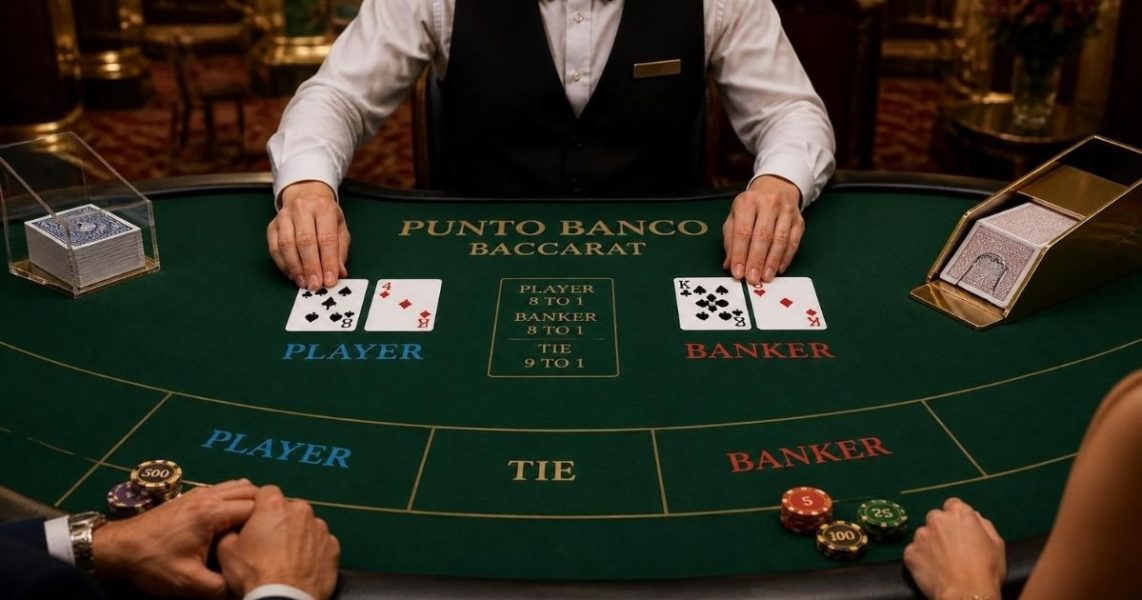
Baccarat comes in a few forms. Punto Banco is the modern standard, where the casino banks and the rules are fixed. Chemin de Fer and Baccarat Banque are older versions where players bank and make choices. Mini and Speed Baccarat are quicker Punto Banco, and EZ Baccarat drops the commission. Most games you meet are Punto Banco.
Almost every game labelled simply baccarat today is one particular version: Punto Banco. But the name covers a family of games, some centuries old, that play quite differently, from the social, decision-driven Chemin de Fer of James Bond fame to the stripped-down Speed Baccarat dealt in live studios. This guide explains each variant, what actually changes between them, and which you are likely to run into. A comparison tool at the end lets you line up any two side by side. If you want the core rules first, our how to play baccarat guide covers the standard game, which is Punto Banco.
- Punto Banco is the default. Fixed rules, the casino always banks, and you make no decisions beyond your bet.
- Chemin de Fer and Baccarat Banque are older. Players take turns banking and choose whether to draw, so skill plays a part.
- Mini and Speed are the same game. Identical rules and odds to Punto Banco, just lower stakes or a faster pace.
- EZ Baccarat drops the commission but adds a push rule, keeping the Banker edge near 1.02 percent.
What are the different types of baccarat?
Baccarat is not a single game but a family of related ones that share the same goal: bet on the hand closest to nine. The three classic members are Punto Banco, Chemin de Fer and Baccarat Banque. Alongside them sit modern casino formats, Mini Baccarat, Speed Baccarat and EZ Baccarat, that tweak the pace or the commission without changing the core.
The single biggest dividing line is who makes decisions. In Punto Banco and its modern spin-offs, nobody does: the drawing rules are fixed and the casino banks every hand. In the older Chemin de Fer and Baccarat Banque, players take turns banking and can choose whether to draw, which is what gives those versions a thread of skill. Everything else, card values and the aim, stays the same as in our baccarat odds guide.
Punto Banco
Punto Banco is the version almost everyone plays. The casino banks both hands and plays them out by a fixed tableau, so there are no decisions to make beyond choosing Player (punto), Banker (banco) or Tie. It is the standard game in Canada, the United States, the United Kingdom and much of the world, and it accounts for the overwhelming majority of baccarat played online and in casinos, including the vast baccarat halls of Macau.
Because the rules are identical everywhere, the odds are predictable: a 1.06 percent house edge on the Banker, 1.24 percent on the Player, and a costly 14.36 percent on the Tie, which is why our baccarat strategy guide says to skip it. If someone says baccarat without naming a variant, they mean this one. So when you read how to play the game, you are learning Punto Banco.
Chemin de Fer
Chemin de Fer, French for railway, is the older, more social ancestor of the modern game and the one James Bond famously plays. Here the players, not the casino, take turns being the banker, covering the other bets, and both the banker and the lead player can choose whether to draw a third card. That element of choice makes it slower and more strategic than Punto Banco, with the casino simply running the table and taking a five percent commission on Banker wins.
It is rare today, surviving mainly in a handful of French and Italian casinos and the occasional high-stakes private room. If you value the social, decision-making side of cards, it is the most engaging form of baccarat, though you will have to hunt for a table.
Baccarat Banque
Baccarat Banque, also called baccarat a deux tableaux (two tableaux), is the earliest form and a close cousin of Chemin de Fer. The key difference is the bank: rather than rotating each losing hand, one player wins the role, usually by staking the most, and holds it until they run out of funds or choose to step down. The banker plays against two player hands at once, one on each side of the table.
Like Chemin de Fer, it involves player choice and is now a rarity confined to some European casinos. For most players it is a piece of baccarat history rather than a game they will sit down to, but it explains where the modern versions came from.
Mini and Speed Baccarat
Mini Baccarat is simply Punto Banco on a smaller, lower-stakes table. The dealer handles every card so players never touch them, the minimums are lower, and rounds move faster. Crucially, the rules and the house edges are exactly the same, so it is the most common way newcomers meet the game on a casino floor.
Speed Baccarat takes that a step further for the online world. Offered by live dealer studios such as Evolution, it compresses each round to around 27 seconds, against roughly 48 for a standard live table, by tightening the betting and dealing windows. Again the odds are untouched; you simply play more hands per hour. Both are Punto Banco underneath.
EZ Baccarat
EZ Baccarat solves an annoyance of the standard game: the five percent commission and the mental arithmetic it brings. Instead of charging commission, it pays Banker wins at even money, with one catch, a Banker win with a three-card total of seven is a push rather than a win. That single rule quietly does the job the commission used to, keeping the Banker house edge low at about 1.02 percent, marginally better than standard baccarat.
EZ Baccarat is common online and across North America, and it introduces two optional wagers tied to its push rule, the Dragon 7 and the Panda 8, which we break down in our baccarat side bets guide. It is not the same as generic no-commission or Super 6 baccarat, which instead pays only half on a Banker win with six and carries a higher edge.
Baccarat variant comparator
Pick any two variants to see exactly how they differ, side by side, across the things that actually matter: who makes decisions, who banks, the commission, the pace, the house edge and where you will find each one.
| Feature | Punto Banco | Chemin de Fer |
|---|---|---|
| Player decisions | ||
| Who banks | ||
| Banker commission | ||
| Pace | ||
| House edge | ||
| Where you find it |
Where to play baccarat variants online
Online, the variants you will actually find are Punto Banco, Mini and Speed Baccarat, and EZ Baccarat, mostly at live dealer tables streamed from a studio, as covered in our online and live baccarat in Canada guide. Chemin de Fer and Baccarat Banque are largely confined to a few land-based European rooms. For Canadian players, a good live casino is the easiest way to try the faster formats and the no-commission game at low stakes.