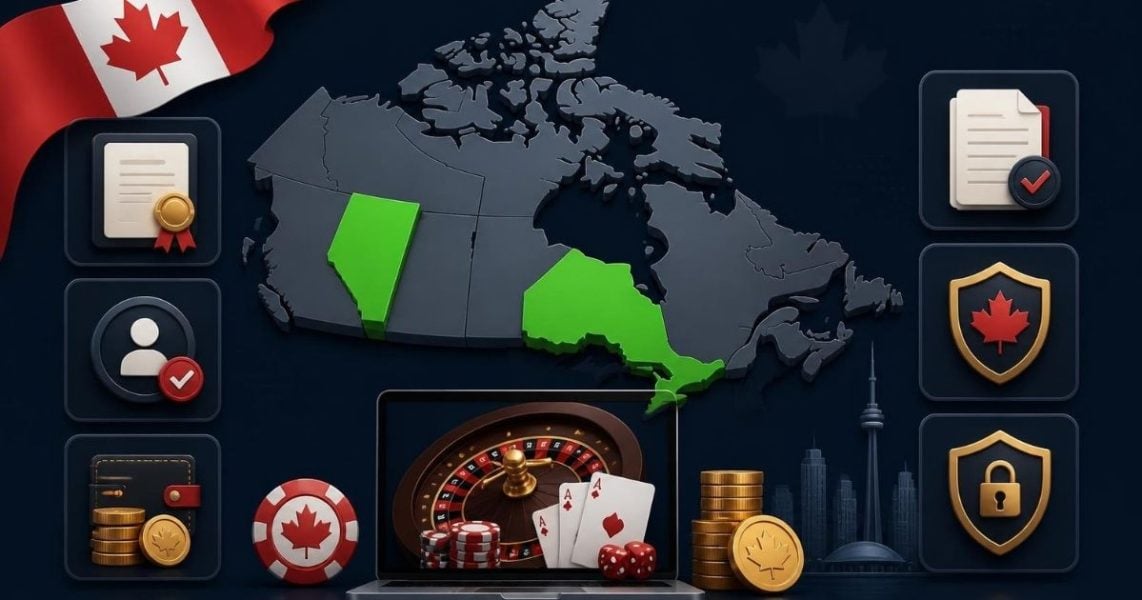
Anyone asking how to start an online casino in Canada is asking a provincial question, not a federal one. Ontario charges C$100,000 per gaming site per year. Alberta charges a one-time C$50,000 application fee plus C$150,000 a year. Both provinces then take roughly a fifth of gaming revenue, and both require a second agreement with a separate Crown corporation before you can accept a single bet.
- There is no Canadian gambling licence. Each province decides who may offer gambling inside its own borders, and only Ontario and Alberta have opened to private operators.
- Registration is the first of two doors. The regulator registers you; a separate Crown corporation signs the commercial agreement. Neither one on its own lets you take a bet.
- The province takes about a fifth of gaming revenue. In Alberta three per cent comes off gross revenue first, for First Nations funding and social responsibility, before the 80/20 split is calculated.
- An offshore licence costs far less and buys something different. A Kahnawake authorisation does not let you serve players in Ontario or Alberta.
What you are actually buying
You are buying two separate permissions from two separate bodies, and you need both. The first is a registration from the provincial regulator, which is a probity decision about whether you and your key people are fit to hold it. The second is a commercial agreement with a Crown corporation, which sets the revenue split and the operating conditions.
In Ontario the regulator is the Alcohol and Gaming Commission of Ontario and the commercial counterparty is iGaming Ontario. In Alberta the regulator is Alberta Gaming, Liquor and Cannabis and the counterparty is the Alberta iGaming Corporation, a Crown corporation created for the purpose. The published fees below buy the first door only. The second door has no advertised price, because the terms sit inside a negotiated agreement.
Everywhere else in Canada, the answer is that you cannot buy in at all. Gambling is conducted and managed by the province, and outside Ontario and Alberta that means the provincial lottery corporation runs the only lawful online casino.
What it costs in Ontario
Ontario charges a regulatory fee of C$100,000 a year for every gaming site you operate, payable with the application and not refunded if you are turned down. Registrants can choose a one or two year term, with the fee payable to match the length of the term.
The per site wording matters more than the number. If you plan to run several distinct online gaming sites, you apply separately for each one and pay the fee for each one. Whether two brands count as one site or two is a determination the Registrar makes, and it turns on things like whether the sites share account credentials across domains and apps. Three brands is three applications and C$300,000 a year, not one.
Suppliers are registered separately and pay far less. A gaming related supplier pays between C$2,000 and C$15,000 a year depending on the classification the AGCO gives it, with C$3,000 the common figure for suppliers of gaming equipment or services and C$15,000 for manufacturers of gaming equipment.
On top of the fees, the province takes a share of revenue under the iGaming Ontario operating agreement. It is a contractual share rather than a tax, and it runs at roughly twenty per cent. iGO’s own published figures bear that out: in the first calendar quarter of 2026 the province recorded around C$226m against net adjusted gaming gross revenue of C$1.13bn.
What it costs in Alberta
Alberta charges a one-time C$50,000 application fee plus a C$150,000 annual registration fee, and asks for an initial deposit of around C$10,000 against the cost of background checks. Alberta collects it as a single upfront payment covering due diligence, where Ontario splits the process into stages.
Alberta’s market opened to private operators on 13 July 2026, which makes it the second province after Ontario to do so. Registration had been open since 13 January 2026 under the iGaming Alberta Act, and by launch day close to fifty entities had paid registration fees while a little over twenty were actually live. Operators that registered but were not ready have until 13 October 2026 to launch or leave.
The revenue split is 80/20 in the operator’s favour, but the base is calculated differently from Ontario’s. Three per cent comes off gross gaming revenue first, two per cent for First Nations funding and one per cent for social responsibility initiatives, and the 80/20 split applies to what remains.
Suppliers pay C$15,000 a year if they are platform providers or critical gaming system providers, and C$3,000 a year for other goods and services categories such as e-wallet providers, sports data suppliers, integrity monitors and testing laboratories.
Because Alberta’s framework is only weeks old, the fee schedule and the go-live requirements are still the most likely things on this page to move. AGLC publishes both, along with the registration guide and the current registrant list, on its own iGaming registration guide. Check any figure there before you budget against it.
What your own first year would cost
The fixed fees are public, so a first year figure is arithmetic rather than guesswork. Pick a province, the number of distinct sites you intend to run, and a rough annual gaming revenue, and the calculator applies the published schedule.
How the two provinces differ beyond the fees
The money is the smaller difference; the compliance obligations are the larger one. Alberta borrowed Ontario’s two body structure but wrote its own assurance requirements, and those drive cost and timeline more than the fee schedule does.
| Ontario | Alberta | |
|---|---|---|
| Regulator | Alcohol and Gaming Commission of Ontario | Alberta Gaming, Liquor and Cannabis |
| Commercial counterparty | iGaming Ontario | Alberta iGaming Corporation |
| Market opened | April 2022, the first in Canada | 13 July 2026, with just over twenty operators live on day one |
| Revenue share basis | A contractual share of net gaming revenue under the iGO operating agreement | An 80/20 split applied after three per cent is deducted from gross gaming revenue |
| Security assurance | Annual independent system and security assessments against the Registrar’s standards | SOC 2 Type 1 attestation before go live, then SOC 2 Type 2 within two years |
| Government competitor | OLG continues to run its own site alongside private operators | Play Alberta continues to run alongside private operators |
What a Kahnawake authorisation costs, and what it does not buy
A Client Provider Authorization from the Kahnawake Gaming Commission costs US$40,000 to apply for, a figure that includes the first annual fee and is refunded if the authorisation is not granted. Authorisations run for five years subject to review, and Kahnawake levies no corporate tax and no separate gaming tax. A 2025 change set the standard annual fee to cover six licensed domains, with a further US$500 a year for each domain beyond that.
Set against C$100,000 a year per site in Ontario, that looks like an obvious saving, and it is the reason the comparison gets made. It is also the wrong comparison, because the two authorisations do different things.
A Kahnawake authorisation does not make an operator lawful for a player in Ontario or Alberta. Those provinces require registration with their own regulator plus an agreement with their own Crown corporation, and nothing issued elsewhere substitutes for either. An operator holding only a CPA and taking bets from Ontario is in the grey market, whatever its licence page says. The cheaper number buys access to a different set of jurisdictions, not a cheaper route into these two.
The costs that never appear in the fee schedule
The published fees are the most predictable money you will spend, and usually not the largest. Four categories sit outside them.
- Investigation cost recovery. Both provinces charge back the reasonable costs of investigating an application, and Ontario says openly that the amount could exceed the C$100,000 registration fee. Alberta asks for a deposit against it upfront.
- Technical certification. Games, random number generators and platform systems have to be tested by an accredited laboratory before go live, and retested when they change materially.
- Independent assurance. Alberta requires SOC 2 Type 1 before launch and SOC 2 Type 2 within two years. Ontario requires annual independent system and security assessments and an audited control activity matrix. These are audit engagements, priced accordingly.
- Integration work you cannot skip. Centralised self-exclusion is a required integration in both provinces, as is regulatory reporting through the regulator’s own channels. None of it is optional and none of it is quick.
What you do not have to pay for
Two costs that operators routinely budget for turn out not to apply in Ontario. You do not need a Canadian legal entity to hold a registration; a foreign company can register and operate provided it meets every AGCO and iGO requirement, so local incorporation is not a barrier to entry.
Marketing affiliates are also generally outside the supplier registration regime. The AGCO’s own supplier guidance names websites that send traffic to operator sites in exchange for a commission among the categories that may not require registration. That does not put affiliates outside the rules altogether, because the advertising and inducement standards still reach the operator whose brand is being promoted, but it does mean an affiliate is not paying a registration fee to exist.
What no amount of money buys is a shortcut through probity. Both provinces run background checks on the company and its key people, and both treat a first come, first served registration queue as a matter of readiness rather than payment. Nearly fifty entities had paid Alberta’s fees before launch and fewer than half of them were live on day one.