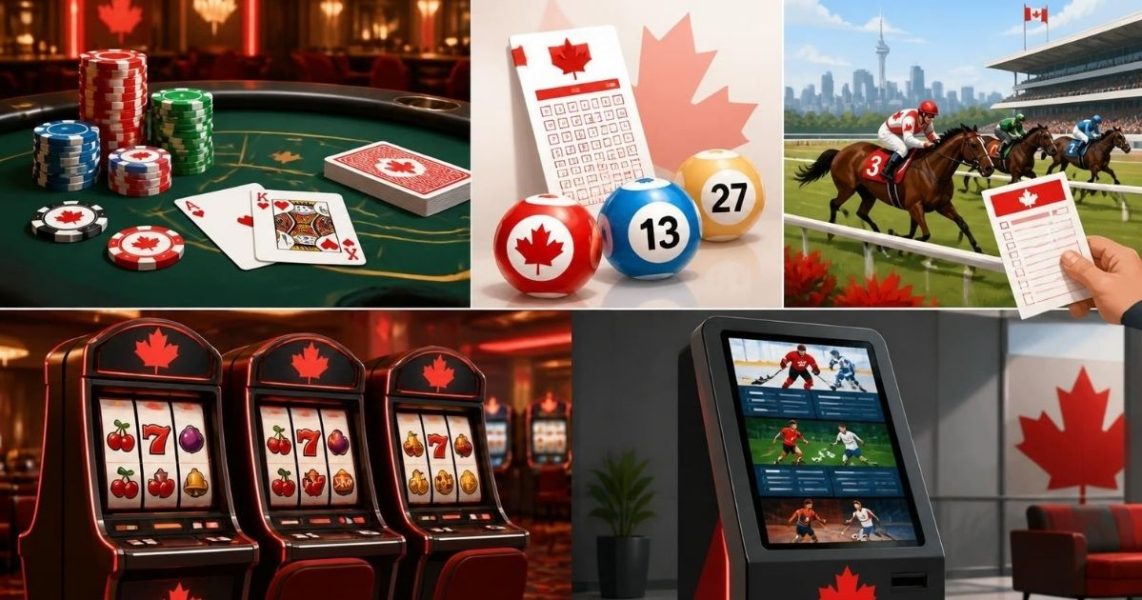
What are the different types of gambling? In Canada there are nine regulated forms: casino games, slots, poker, sports betting, horse racing, lottery, scratch cards, bingo and charitable gaming. What separates them here is not how they are played but who is legally allowed to run them, which differs by form and by province.
- Provinces conduct and manage gambling, under an exemption in the Criminal Code. That single rule shapes every form on this page.
- Only Ontario and Alberta allow private operators. Everywhere else a single provincial platform is the legal option.
- Horse racing is the federal exception. Pari-mutuel betting is overseen by a federal agency, not by your province.
- Charitable gaming is its own category, licensed to organisations rather than operated commercially.
Sorting gambling by how each game is played tells a Canadian reader almost nothing useful. The question that decides things here is who is legally permitted to run each form, because that determines where you can play it, how old you have to be, and what protection you get if something goes wrong.
Why Canada sorts gambling by who runs it
Commercial gambling is prohibited in Canada by default, and everything legal exists inside a carve-out granted to the provinces.
The Criminal Code bans gaming and betting as a general rule, then exempts lottery schemes conducted and managed by a provincial government. That phrase, conducted and managed, is the hinge. It is why every legal form of gambling in the country traces back to a provincial body somewhere, even when a private brand name is on the website.
Two provinces have used that authority to build competitive markets. Ontario opened one in April 2022 and Alberta followed in July 2026, both by creating a state corporation that holds agreements with private operators while a regulator supervises them. Everywhere else, the province runs a single platform itself and that platform is the only lawful option.
The exception is horse racing, and it is written into the same section. The Criminal Code expressly excludes bets on horse races made through a pari-mutuel system from the provincial carve-out, and routes them instead to a separate provision. Pari-mutuel betting, where wagers go into a shared pool rather than against a bookmaker, is supervised federally by the Canadian Pari-Mutuel Agency. It is the one form where your province is not the deciding authority.
What are the different types of gambling in Canada?
Ten regulated forms, grouped below by the body that is legally permitted to run them rather than by how the game is played.
Use the filter to narrow the list. Most people want one of two views: what a provincial platform offers where they live, or what opens up in the two provinces that licence private operators.
Showing all 10 forms.
The classic casino floor games. Available through your provincial platform everywhere, and through registered private operators in Ontario and Alberta.
Blackjack guideA pure chance game with a fixed house edge that does not change with how you bet. Widely available online and in land-based venues.
Roulette guideThe most socially played game on a casino floor, and the one where the difference between bet types matters most to the maths.
Craps guideSimple to play and among the lowest house edges on the floor, which is why it carries the reputation it does among high-stakes players.
Baccarat guideThe largest category by volume. Outcomes come from a random number generator, and in Ontario the regulator also sets harm-reduction rules on how they may behave.
How slots workPlayed against other players rather than the house, which is why player pools and their size matter more here than in any other form.
Poker guideSingle-event betting became legal across Canada in 2021. In Ontario the age also splits by channel: 18 at a retail counter, 19 online.
Ontario betting appsThe outlier. Bets go into a shared pool rather than against a bookmaker, and the Canadian Pari-Mutuel Agency supervises it nationally rather than any province.
Run exclusively by provincial corporations such as OLG, Loto-Quebec, BCLC, ALC and WCLC. No private operator sells a Canadian lottery ticket, in any province.
How scratch cards workRaffles, charity bingo and similar events run under licences issued to organisations rather than to commercial operators, with proceeds directed to the cause.
Is online gambling legal in Canada?
Yes, where you are playing on a platform your province conducts and manages, or on a private operator it has licensed.
The question trips people up because the answer is neither a flat yes nor a flat no. Gambling is not illegal for the player. What the Criminal Code regulates is who may offer it. So the honest answer to “is this legal” is always about the operator rather than about you.
That gives three situations. In Ontario and Alberta you may play with any operator registered by the provincial regulator and holding an agreement with the provincial corporation. In every other province the lawful option is that province’s own platform. And offshore sites, which serve Canadians without any provincial authority, sit outside the framework entirely.
Playing at an offshore site has not historically been treated as a criminal matter for an individual Canadian. But it means no provincial recourse if a withdrawal is refused, no access to province-wide self-exclusion, and no regulator to complain to. Our guide to what an offshore licence actually means covers why a licence issued elsewhere is not a substitute.
Who runs gambling where you live
Every province has a corporation that conducts and manages gambling, and in two of them a regulator sits alongside it licensing private operators.
| Where | Who runs it, and what that means for you |
|---|---|
| Ontario | OLG runs the provincial platform, while the AGCO registers private operators that hold an agreement with iGaming Ontario. The widest legal choice in the country. |
| Alberta | AGLC regulates and the Alberta iGaming Corporation holds the operator agreements, alongside the government’s own Play Alberta. Open since July 2026. |
| Quebec | Loto-Quebec, through its Espacejeux platform. A single provincial option, with no private licensing regime. |
| British Columbia | BCLC, through PlayNow. One platform, provincially operated. |
| Atlantic provinces | Atlantic Lottery Corporation serves New Brunswick, Nova Scotia, Prince Edward Island and Newfoundland and Labrador. |
| Prairie provinces | Western Canada Lottery Corporation covers Manitoba and Saskatchewan, with each province running its own gaming arm alongside it. |
| Territories | No local online platform of their own. Residents rely on national lottery products through WCLC. |
If you live outside Ontario and Alberta, the practical position is that your provincial platform is the only site operating under rules your province can enforce. Everything else you can reach is offshore, whatever it says about itself.
Which type of gambling suits what you are after
The forms differ less in odds than in pace, and pace is what decides how much a session actually costs you.
Lottery and scratch cards are the slowest. One purchase, one outcome, no decision to make and nothing to chase. The odds are the worst of any form on this page by a wide margin, but the structure makes it very hard to lose more than you intended.
Table games sit in the middle. Blackjack, baccarat and craps carry some of the lowest house edges available, and each round takes long enough that a session has natural stopping points. Poker is the only form where you are playing other players rather than the house, which changes the shape of the thing entirely.
Slots and in-play sports betting are the fastest, and speed is the variable that matters most. A low house edge applied many times an hour costs more than a high one applied twice. That is why Ontario’s regulator sets minimum spin durations and bans auto-play rather than regulating the odds themselves.
None of this makes any form a way to make money. Every one of them is priced so the operator keeps a margin over time, and the difference between them is how quickly that margin is collected. Our beginner’s guide to online casinos covers the practical side of getting started safely.
What none of these forms will do
Every form of gambling on this page is designed to return less than it takes over time, and no amount of choosing between them changes that.
It is worth saying plainly because a lot of writing on this subject implies otherwise. There is no form here with better long-run economics than the others in any way that would matter to a player, and there is no technique that alters the odds of a lottery draw or a slot spin. What differs is the pace, the size of the margin and how visible it is.
Treated as entertainment with a cost attached, all of it is fine. Treated as a way to make money, none of it works. If gambling has stopped feeling like the former, our responsible gambling guide has a confidential self assessment, practical limit-setting tools and free support lines for every province and territory.