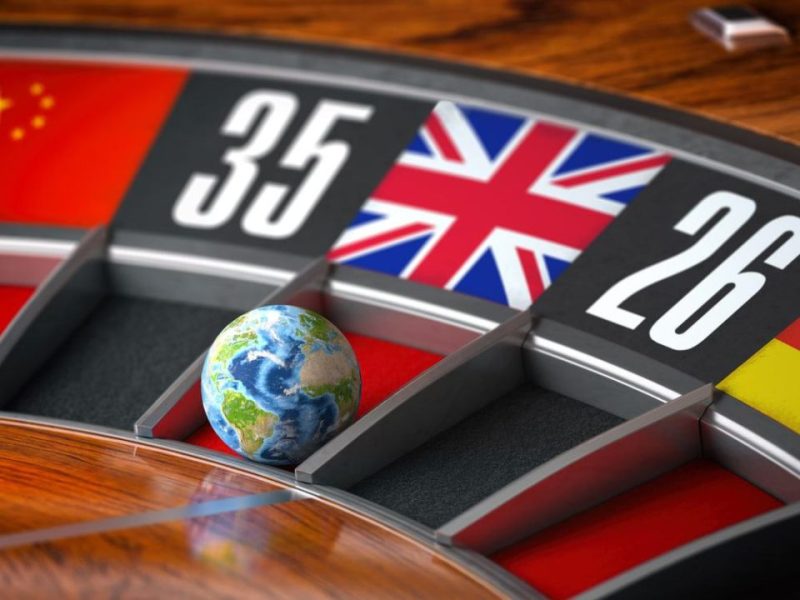
The biggest gambling countries are not the ones with the most famous casinos. We have all heard of, or even visited, Macau and Las Vegas, and those cities draw millions of visitors a year. Neither China nor the United States, though, comes near the top when losses are measured per adult.
The ranking below follows the research of H2 Gambling Capital, which totals a year’s gambling losses in close to 200 countries, across slots, table games, bingo, lotteries and sports betting, and divides them by the adult population.
Its last openly published per-capita league tables, for 2016 and 2017, still set the order. Where a country has published newer national figures, we use those in the text and say which year they cover.
The biggest gambling countries: the ten largest losses per adult
Per-adult losses are the fairest comparison because they strip out population size. On that measure the top 10 gambling countries are a handful of small, wealthy, well-regulated markets that outspend the giants, and the same names have sat at the top of the table for more than a decade.
Australia
US$958 per adultAustralia remains, without question, the world’s number one gambling nation when measured by losses per adult. H2 Gambling Capital put the figure at US$958 in 2017, a quarter ahead of second-placed Hong Kong, and the gap has not closed since.
The latest national figures are starker. Australians lost about A$31.5 billion in 2022-23, roughly A$1,500 for every adult, and the Grattan Institute puts the average at A$1,635 per adult, the highest in the world.
The driving force is the “pokies”: slot machines embedded in pubs, clubs and dedicated venues. Australia has one of the highest densities of gambling machines anywhere, and most of its losses come from pokies and sports betting rather than casinos.
A full advertising ban, recommended by a parliamentary inquiry in 2023, has still not happened. The bill the federal government introduced in July 2026 caps television ads before 8.30pm and bans them in stadiums and on jerseys, but stops short of the total ban, and was sent to a Senate inquiry.
Hong Kong
US$768 per adultHong Kong is second on H2 Gambling Capital’s per-adult table, at US$768 a year. What makes it unusual is how tightly the legal market is controlled: the Hong Kong Jockey Club is the only body authorised to offer horse racing, football betting and the Mark Six lottery, a near-total monopoly.
Despite this, illegal gambling remains widespread across the territory, which means the true losses are likely higher than the official figures suggest.
Singapore
US$725 per adultSingapore has one of the highest rates of gambling losses per adult in the world, at US$725 a year. It is a remarkable figure for a city-state with only two licensed casino resorts, Marina Bay Sands and Resorts World Sentosa, and a single state-run operator, Singapore Pools, for lotteries and sports betting.
The government deliberately prices locals out: Singapore residents pay a casino entry levy of S$150 a day or S$3,000 a year, and the National Council on Problem Gambling’s surveys show problem gambling prevalence falling from 2.6 per cent in 2011 to below 1 per cent by 2017.
Finland
US$515 per adultGambling was introduced in Finland in the 1920s with the establishment of the state lottery, and the industry has grown considerably since. The average gambling loss per adult stands at US$515 a year on H2 Gambling Capital’s table.
A 2019 national study found that around 78 per cent of Finns aged 15 to 74 had gambled in the previous year, with 29 per cent gambling at least once a week. The most popular forms are lotto, scratch cards and slot machines, and people aged 25 to 44 are the most active group.
Finland is also mid-way through the biggest change in its gambling law for decades. The state monopoly Veikkaus is being opened up: a licensing system for online casino and betting operators was approved in 2025, and the licensed market opens at the start of 2027.
Ireland
US$490 per adultGamblers in Ireland lose a sizeable US$490 per adult each year, reflecting a deeply embedded betting culture. For decades the country relied on outdated laws, parts of which dated from 1931 and 1956.
That has now changed. The Gambling Regulation Act 2024 created a single regulator, the Gambling Regulatory Authority of Ireland, which was formally established in March 2025 and is phasing in licensing, advertising limits and a national self-exclusion register.
Ireland is also home to several major international gambling companies that have chosen Dublin as a base, which underlines its weight as a global gambling jurisdiction.
New Zealand
US$454 per adultThe average gambling loss per adult in New Zealand is US$454 a year, placing it firmly among the world’s most gambling-prone nations. Much like its neighbour Australia, New Zealand has a strong pokie culture, with machines widely available in pubs, clubs and TAB venues.
Online casinos were unregulated until 2026. The Online Casino Gambling Act 2026 now licenses up to 15 online casino brands, with licences issued from early 2027, and the regulations ban credit-card deposits, autoplay and affiliate marketing. Our guide to how New Zealand’s online casino licensing works covers the dates that matter.
United Kingdom
£16.8 billion GGY 2024-25The UK does not top the per-adult rankings, but it runs one of the largest and most mature regulated markets in the world. The Gambling Commission’s industry statistics put total gross gambling yield at £16.8 billion for April 2024 to March 2025, up 7.3 per cent, with the remote casino, betting and bingo sector at £7.8 billion, up 13.1 per cent.
Online is where the growth is. Remote operators reported 24.4 million active accounts at the end of the period, and the remote sector now takes close to half of all gambling yield once the National Lottery is included.
Advertising around sport remains the live political question, and the Commission’s 2023 White Paper reforms, from stake limits on online slots to financial vulnerability checks, have been rolling out since 2024.
Canada
US$568 per adult (2016)Canada sits in the top ten on H2 Gambling Capital’s 2016 table at US$568 per adult, and most of that money runs through provincial lottery corporations, which hold the monopoly on gambling in every province. Roughly two-thirds of Canadians gamble in a given year, predominantly on lotteries.
Online is the part that is changing. Two provinces now run open, competitive online markets: AGCO-registered Ontario casinos since April 2022 and AGLC-registered Alberta casinos since July 2026. Elsewhere in Canada, the provincial platform is the regulated option.
Ontario alone produced $4.0 billion in operator revenue on $98.3 billion of wagers in 2025, and 91.1 per cent of its online players now use regulated sites. Read the full breakdown in our Ontario iGaming revenue report.
Italy
US$517 per adult (2016)Italy is an often-overlooked gambling powerhouse with a rich heritage in the pastime. After loosening its gambling laws from 2006, it grew into one of Europe’s largest markets: Italians stake more than €150 billion a year and lose around €20 billion of it, which H2 Gambling Capital’s 2016 table put at US$517 per adult.
The country’s gambling culture stretches back centuries, and baccarat is usually traced to Italy. Today the money is in slots, lotteries and online play rather than casinos: Italy has only four licensed casinos, at Venice, Sanremo, Saint-Vincent and Campione d’Italia.
Spain
US$418 per adult (2016)Spain rounds out the top ten at US$418 per adult on the 2016 table, with a distinctive gambling identity. Rather than gravitating towards slots and table games, Spaniards have a well-documented passion for sports betting, a natural outgrowth of the country’s sporting culture across football, tennis and motorsport.
Online gambling has been licensed nationally since 2012 under the regulator DGOJ, and since 2021 Spain has had some of the strictest advertising rules in Europe, confining most gambling ads to a late-night window and banning sponsorship on football shirts.
A Global Industry With No Brakes
For the biggest gambling countries, wagering is a multi-billion dollar industry that represents both a significant cash injection into national economies and a serious public health challenge.
Online is where the growth now sits. The UK’s remote sector grew 13.1 per cent in 2024-25, and Ontario’s regulated online market grew 34 per cent in 2025. The question for regulators is whether consumer protection, from Australia’s loss limits to New Zealand’s advertising ban, can keep pace with an industry that shows no sign of slowing down.
Gambling is entertainment, not income. Every figure on this page is money players lost. If gambling has stopped feeling like entertainment, use our quick self-assessment; free, confidential support lines for every province and territory are on our Responsible Gambling page.
19+ (18+ in Alberta, Manitoba and Quebec). Play responsibly.
Sources
- H2 Gambling Capital, per-capita gambling losses by country, 2017, as reported by ABC News, November 2018
- Equity Economics for the Alliance for Gambling Reform and Wesley Mission, Australian gambling losses 2022-23 (A$31.5 billion, A$1,527 per adult)
- Grattan Institute, A better bet: How Australia should prevent gambling harm, September 2024
- Parliament of Australia, gambling advertising bill introduced July 2026 and referred to a Senate inquiry
- UK Gambling Commission, Industry statistics annual report, April 2024 to March 2025
- GAMSTOP, registrations for the first half of 2024
- iGaming Ontario, market performance reports for calendar 2025; Ipsos channelisation survey for the AGCO and iGaming Ontario, 2026
- National Council on Problem Gambling (Singapore), gambling participation surveys 2011 to 2017
- Gambling Regulatory Authority of Ireland, establishment under the Gambling Regulation Act 2024
- Department of Internal Affairs (New Zealand), Online Casino Gambling Act 2026 and regulations
- Agenzia delle Dogane e dei Monopoli (Italy), annual gaming data
- Dirección General de Ordenación del Juego (Spain), online gambling market reports and Royal Decree 958/2020 on advertising